
Seattle Jewish Community Hospital train, approximately 1943-1944. Workmen's Circle in conjunction with several Jewish agencies, purchased two trains of thirteen cars that were loaded with medical supplies and amenities for troops as part of their operations to support the war effort.
Courtesy of UW Special Collections
Seattle Jewish Community Hospital train, approximately 1943-1944. Workmen's Circle in conjunction with several Jewish agencies, purchased two trains of thirteen cars that were loaded with medical supplies and amenities for troops as part of their operations to support the war effort.
Courtesy of UW Special Collections
Haggadah
We've all lived through significant historical events, and this serves as a record of our experiences and actions — a Haggadah of our time.
Haggadah loosely translates to TELLING. In 2020, the community shared their stories with us. What changes did you make in your everyday lives, and how did they impact your plans for the year? How did you stay connected with friends and family during social distancing? How were your education or business affected? How was that year different from any other year?
The bonds that connected us as a society changed, but our Jewish values provided a framework that helped us persevere. Interested in hearing more stories? View this playlist.
Your Individual Stories
Below are stories submitted by community members reflecting on their experiences during the COVID-19 pandemic, including their day-to-day lives and how they navigated that time. Scroll through to explore their stories and hear their experiences in their own words.
Alkan Anniversary
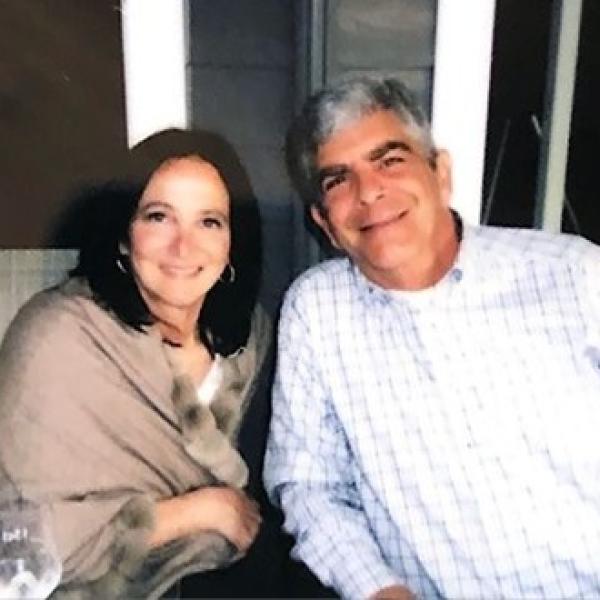
"How do you celebrate an anniversary during a pandemic? My husband and I celebrated our 29th anniversary on July 7. Our amazing daughter (who is now living at home with us unexpectedly due to Covid) planned and executed a beautiful evening at home, more exceptional than any we could have had at a restaurant. She acted as Maitre D’, sommelier, waitress, and chef. She set a beautiful table with flowers and framed pictures. She selected an anniversary playlist and insisted we dress up. (Good excuse to get out of those sweats and put on some makeup!) Everything was perfect and prepared with so much love. It was a wonderful evening, one we’ll always remember!"
- Alkan Family
Dean Altaras
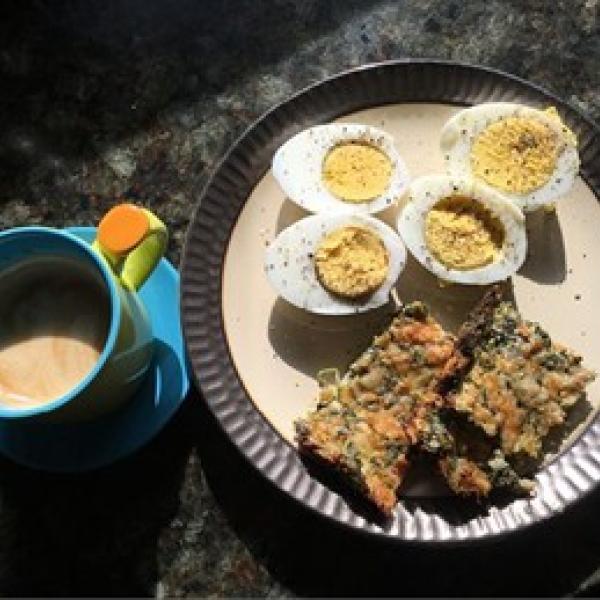
"In terms of family and friends, food, and the significance of the age-old story, Passover has always been my favorite holiday. I have been blessed to celebrate both the Ashkenazi and Sephardic traditions throughout my life. This year, will certainly be different as we all observe Passover miles apart in our new virtual world; however, it will be the taste and smell of the food that will bring us all back to the table together in spirit. While I will miss my brother's gefilte fish, I'll be making my Spinach Quajado (quiche) and Passover brownies. With eggs and coffee, they make the perfect desayuno (breakfast) throughout the holiday!
Thanks to the many Jewish organizations that have been providing Haggadahs and supplements for all of us to utilize. This year will no doubt be different, but it will still be special in its own way. Chag Pesach Sameach."
- Dean Altaras
Joel Arensberg
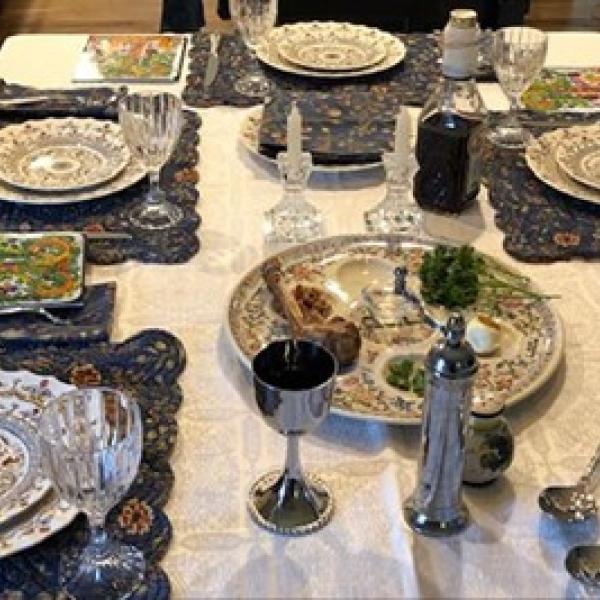
"Since the "stay home, stay healthy" mandate was imposed, our family dinners have been less frequent. However, this year's Seder brought my family together for more than 20 minutes. My wife, Amy, prepared and cooked a fabulous Passover dinner. Our 15-year-old twins led the Seder. All of us read from the Haggadah, sang Dayenu, and had great conversations about Passover, Covid-19, and everyday topics.
It will be great to actually hug family and friends again. But it will be even greater to have multiple generations sitting together again at next year's Seder table."
- Joel Arensberg

Matthew Coopersmith
I run a sole proprietorship called Coopersmith Tutoring. I meet my clients at their houses and help them with their academic needs. For a number of weeks in March, things were looking dim for my business, but fortunately, I've been able to move most of it online. I'm lucky I'm still able to provide my students with the help they need.
- Matthew Coopersmith
Esfeld Family Seder
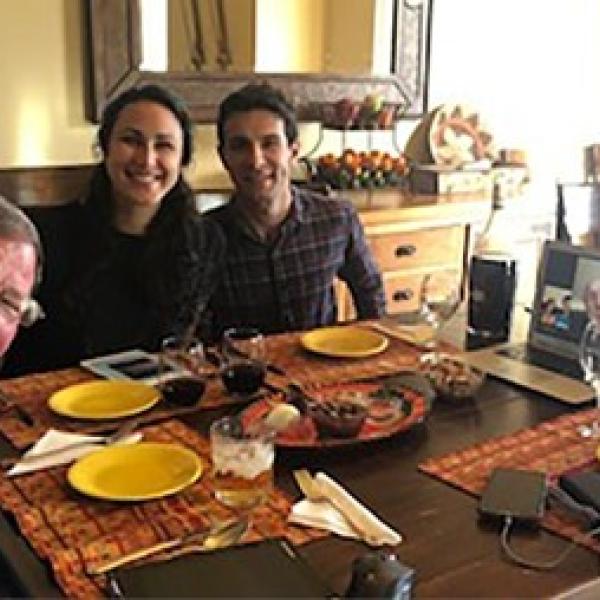
Safely together: Josh Esfeld, Gilli Mizrahi, Jeff Esfeld, Janet Esfeld, Photographer. We are in Utah
On screen: Don Esfeld (Rancho Mirage, CA), Sam & Eva Hanan (Bellevue, WA), Jordan Esfeld & Marcus Vizzutti (New Orleans, LA)
- Esfeld Family
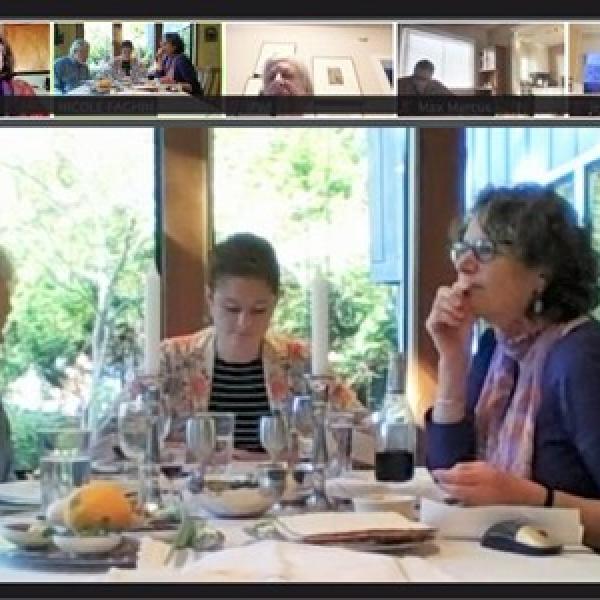
Lori Ann Faghin
"We are doing a ZOOM Seder, which in a way is good because no one needs to fly out and stay in a hotel. My new boyfriend and his sister and brother-in-law will be joining for the first time also virtually. This is also the first year my sisters and I are orphans, so distancing and no parents will be interesting. I normally lead the Seder, but my nieces want to do it this year. I’m down with that. It will be beautiful, and we will sing the unique Faghin tunes. A joy."
- Lori Ann Faghin
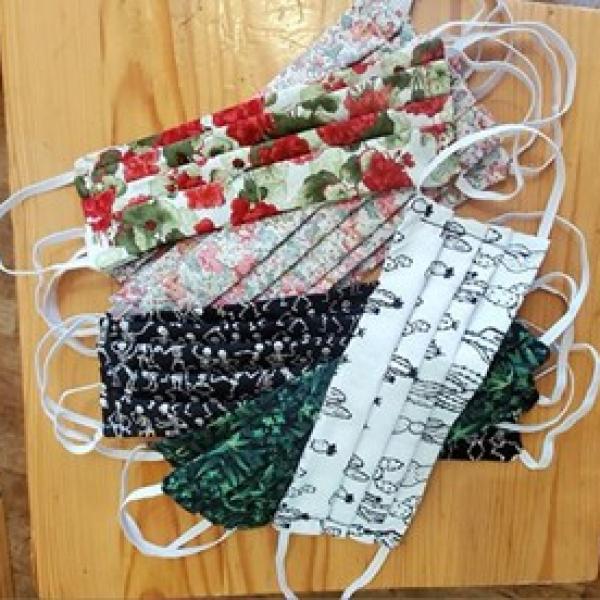
Marni Jennifer Good
"Masks.
I make these.
Using materials on hand or donated by friends and community members.
For people who need them.
For people who will wear them.
This is my community service."
- Marni Good
Hirshberg-Koehler-Kezner Families
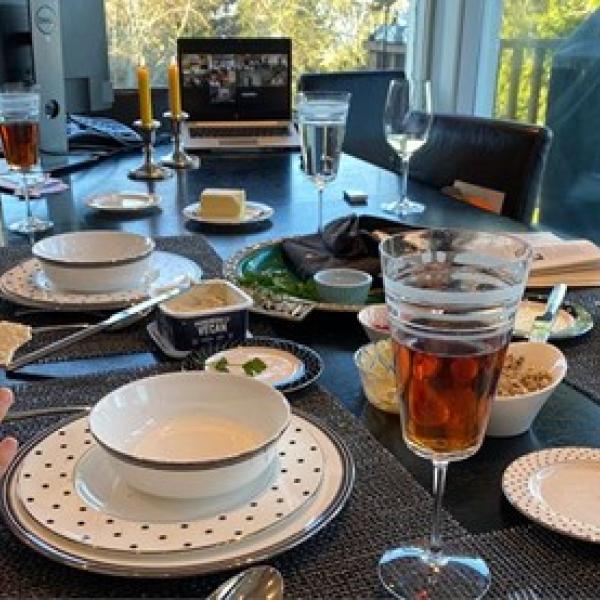
"The Hirshberg/Koehler/Kezner extended families took their Seder to Zoom this year. Each year, the Seder gathers 40+ family and friends from across the Seattle area, and this year, Zoom allowed the tradition to continue. We found a copy of the Union Haggadah online that we have used as a family for 50+ years. Trying to virtually read in unison was quite comical, but overall, everyone ended up thankful for our health and love for our family."
- Hirshberg-Koehler-Kezner Families
Kranseler Family
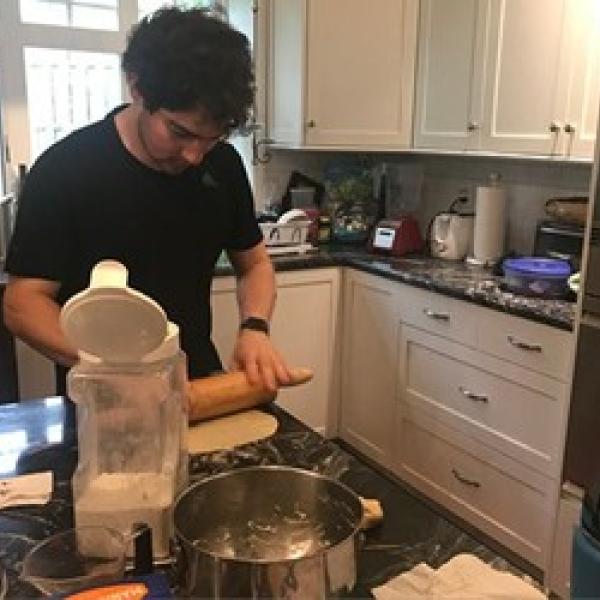
"When you don't have any matzah in the house at the time of Passover, what do you do? You enlist your son, Daniel Kranseler, to make matzoh! It is a process, but fairly quick and easy for Chef Daniel. Rising to the task, he also created Passover macaroons, chocolate cake, brisket, and other Passover delicacies. But the matzoh making was brand new, and it has been the best tasting matzoh around. Being socially distanced with Chef Daniel is certainly not the toughest, with his creativity and food inspirations."
- Kranseler Family
Andrew Kranseler
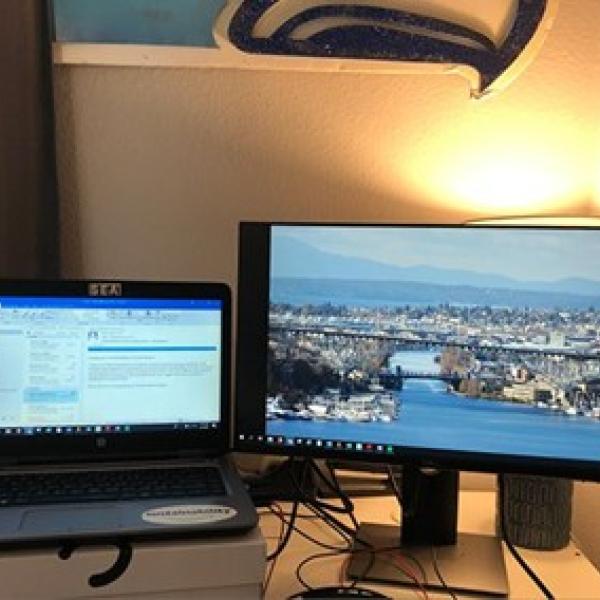
"Since early March, like many others, I have been working from home at Amazon. While it may not be preferable, I understand the necessity & I feel fortunate enough to have a job that allows me to work remotely. I appreciate the flexibility to ensure I am staying healthy in a time of crisis. I am thinking about others during this time who are in a less flexible position, specifically healthcare workers, and those who have lost their jobs."
- Andrew Kranseler
Cindy Diane Frank-Linkon
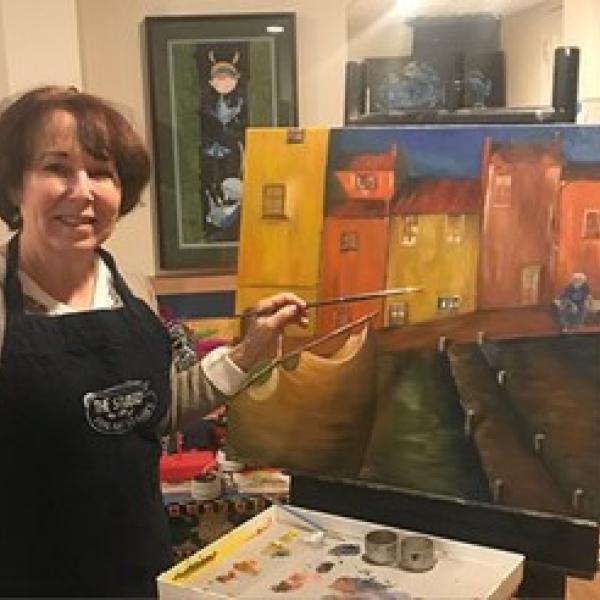
"My name is Cindy Linkon, the owner of a small business called The Studio Fine Art Classes.
When we had to close due to the COVID-19 Virus in our community, many of our students were disappointed. As much as I knew, we were doing the right thing by closing, it was sad for my staff and me.
My staff is now all temporarily unemployed. They are like family, and it’s difficult for me to see them not working. I found creative projects for staff to do at home in order to earn money. They are appreciative.
In the meantime, I’m busy at home with my family and getting to projects that have been on the back burner for some time. I have more time to connect with family and friends through social media, and even find time to get back to something I enjoy, which is oil painting.
Most of all, I am looking forward to the day both studios can resume classes and hear the happy chatter of students learning and my staff instructing the basics of fine art."
- Cindy Diane Frank-Linkon

Joel Migdal
"My wife and I spent Passover this year in our apartment, overlooking the near-empty streets of Jerusalem (see the accompanying photo). Like many others here, we used Zoom to conduct the Seder with friends. What made the day truly unusual was that, when we woke up the morning after, we were able to join our daughter and son-in-law's Seder in progress in Seattle. Sometimes, the ten-hour time difference works in your favor.
How do we make meaning together when we’re physically separated? How do we not just live through this pandemic, but how will it change us? These were a few questions we brought to our virtual Passover table conversation.
Our seder began with candlelighting, a collective attempt to bring light in a dark time. We read the ancient story of Exodus and considered what this moment asks of us, as the Israelites asked themselves. We asked the four questions in multiple languages. We looked back to look forward, listening to the meaning of Pesach from a Syrian refugee who inspired empathy and compassion for our shared humanity and made the fundamental idea in the Passover story of “welcoming the stranger” all the more visceral and real.
We marked the unusual constraints and mixed emotions of hosting a Passover gathering in the midst of a global pandemic and also gave ourselves permission to be joyful; delighting in five year-old Liam Shmuel’s lego creation of our ancestors' epic crossing of the Sea of Reeds and dancing with absolute freedom to “A Tribe of Brothers and Sisters” (Shevet Achim VeAchiyot) performed by some of Israel’s most popular singers with a message of unity and love for Israel.
On this Passover like no other, age–old questions about the holiday never felt more poignant, and our Menasce family and friends never felt more grateful for being able to unite, heal, and bond over one big, beautiful global seder!
- Joe Migdal
Joan Rudd
"The meaning of life is life itself. Or, Real life vanquishes ghosts.
When Joe read the Four Questions in Russian, the two birds showed up. Red-breasted robins, large, fat ones, flew screeching, as I remember it (a sound typically given by those defending nests or fledglings), past our kitchen window and on past the dining room. One continued on past, veering to the south, but flying somewhat erratically, not straight, calling out all the while.
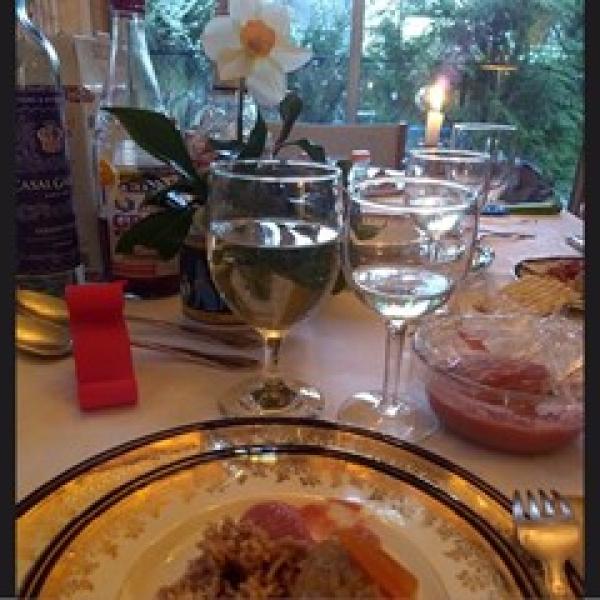
The other, larger bird, perched on our fence, not 12 feet from the glass patio door, and fixated on the scene inside with its beady, left eye. What could it see? Candlelight, me, Joe, the laptop open on the table with the images of our Seder friends on the screen, Joe holding a book open with the Cyrillic characters? I had just finished the Four Questions chanted in Yiddish, and before I chanted them, Joe’s colleague Fred had sung them beautifully in Hebrew.
But the bird stopped to listen, so it appeared, to the Russian version, and perhaps to see us using Grandma Weinberg’s damask tablecloth, and her Pesadike dishes, bought well after WWII, rimmed in gold, glittering perhaps in the candlelight. Then the bird flew off, confidently, apparently satisfied, in the same direction as the first had fled.
And I thought of my grandparents of the gold rimmed dishes, who after the pogroms fled the shtetl for the big Russian cities, and after the Russian Revolution fled Odessa for France, and just before the Nazi invasion of Paris fled to New York, and I myself who fled the teeming cities of the East and continued Westwards, to the suburban open spaces of Seattle, where a bird is just a bird, unless it still longs for its native tongues."
- Joan Rudd
Linda Lawson Elman
"It’s been hard to wrap my head around Pesach this year. It became obvious to me that our annual family Seder with my brother, his family, and other nieces, nephews, cousins, great-nieces, and great-nephews wasn’t going to happen.
It was the Chabad Seder kit that really helped me get my focus. Being able to pick up the shmurah matzah, little containers of everything you need for the Seder plate- where was I going to get horseradish otherwise?- helped me see that we could celebrate Pesach this year, in the midst of the plague of Corona, just not in the usual way.
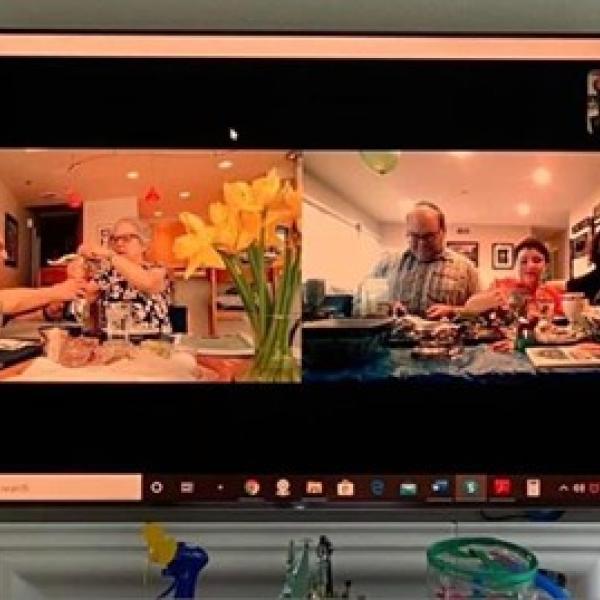
So the seders will be different. On the first night, we will share the story of Pesach with our son Joshua and granddaughter Sierra for the first time ever via Skype. We will sit down separately for our meals, much simplified this year, alone, but together.
On the second night, we will share electronically with our other son, Adam, his wife, Tobi, and our grandson, Robbie. Tobi is a Jewish educator who normally celebrates Pesach with her exuberant family in Calgary. This year, like the rest of us, she’s home in California, planning two seders that I suspect neither we nor they will ever forget.
Tonight, we tell our story of our exodus from Egypt, and perhaps, it will help us look forward to our exodus from our quarantine."
- Linda Lawson Elman
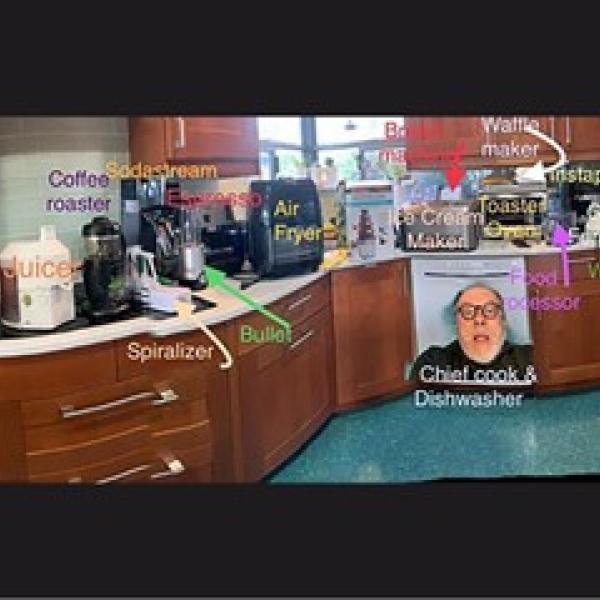
Don Goldberg - Social Isolation and Fascinating Rhythm
"Social isolation, you let me stay at home
Social isolation gives me shpilkes
Even in my kitchen, I am distancing the food
My brisket’s 7 feet from where my milk is
This year the seder’s me and my spouse
9 plagues, one virus, and Maxwell House
We were slaves in Egypt; now we’re slaves at home
Ordering from Amazon and Grubhub
Hoping they’ll deliver, maybe send a drone
We’re the house whose door is smeared with lamb's blood
Cover your mouth with each Barukkha
Instead of kha, try more cha cha cha.
Social isolation, the matzah’s shtupped me up,
Constant constipation is not an issue.
Hide the afikomen, don’t cover it in cloth
Wrap it in a roll of toilet tissue.
With fingers dipped in wine, we will tell
The story, but this year, use Purell.
Still, we’ll set the table, leaning to the left
Keep an empty chair or two beside ya
Keeping with tradition, I’ll open up the door
Wash your hands, before your drink, Elijah
Four questions, not this year, it’s just God, dub-ya Tee Uff.
Social isolation dayenu dayenu dayenu dayenu I’ve had enough."
- Don Goldberg
Silverman and Pena Family
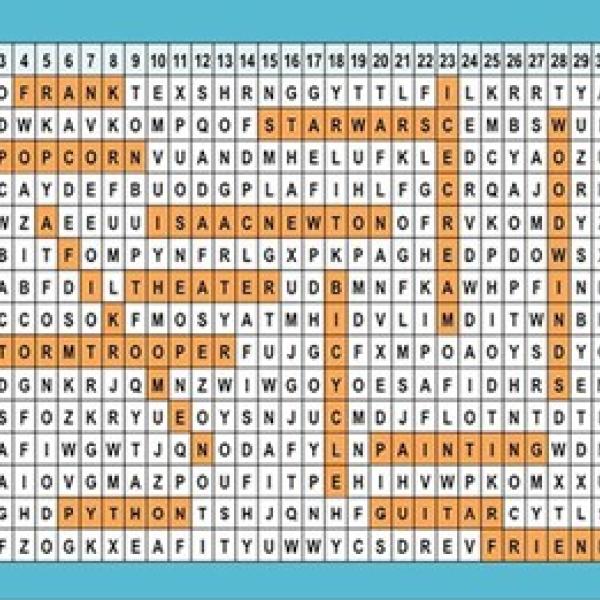
"This is how we tried to bring the Find the Afikomen tradition into the Zoom virtual world using a word search I created for our family and friends. The first slide introduced the rules. The second slide was the word search itself and the third slide showed all the final answers when everyone was done - this third slide is visible above. I "shared my screen" during the game so everyone could get a clear digital image to see. The additional words I incorporated into the Word Search were unique to the loves and hobbies of the attendees of our sedar. In addition to the competitive "be the first to find it" play moment, it also offered a bonding kind of connection moment as we acknowledged and called out the things we knew one another loved."
- Marisa Pena
"I want to share a very special aspect of our seder. We were sixteen individuals, scattered across the country in five homes in the Seattle area and one in California. We were using Zoom and managing quite well with the candles, the seder plate, Elijah’s cup, etc., with Don and me on First Hill, and each household supplying their own dinner, except for the afikomen. We toyed with different ideas, and then my daughter-in-law, Marisa Pena,who is a professional game designer, said that she would create a little word game, “find the afikomen.” So at that point in the seder, Marisa shared her game on screen and we all got to see it. There were several other words in the grid besides afikomen—matzah, wine, haggadah, etc. The first person to find the afikomen and call it out won the game, with second prize going to whoever found the most other words. I don’t know who won (it wasn’t me) but we all had a lot of fun with it."
- Goldie Silverman
Jackie Williams
"Our Seder, as everyone's, was virtual and included friends and family from Texas, California, Kentucky, Wisconsin, and, of course, Seattle. Most were Jewish, but I have two very good non-Jewish friends who had never been to a Seder. For them, I gave explanations and told stories about my family's Seders, going back 80 years. My Great Aunt Mary, who we all adored, would visit and every day made a Sponge Cake using 10-12 eggs. We had to be very quiet so the cake “would not fall”.
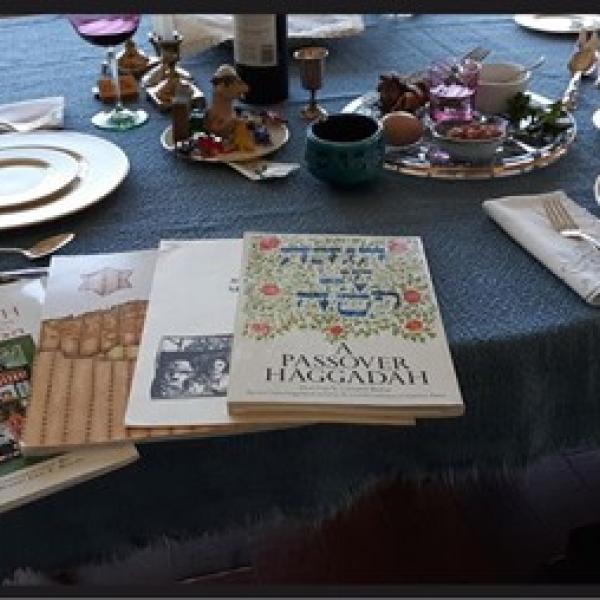
I also set my table using my good China and silverware. At times, I felt I was setting the table for guests who would soon arrive. I would tell myself, “Jackie, no one is coming.”
There was much laughter as we tried to make sense of Zoom. When it was over and all “had left,” I cried.
When I married Buddy, we always had a Seder. Even if we skied during Passover, I would bring all the trimmings. One year, we were having Seder at Bend, Oregon, with Marcia and Dick Porus when the doorbell rang. The clerk from the Inn we were staying in handed us a bottle of wine. Of course, it was a mistake, but we all laughed, saying it was from Elijah.
In 1956, when we lived in Bloomington, Indiana, a town with only one Jewish family. My mother sent a care package of Matzoh, etc. When I asked her about brisket, she said: "Just ask the butcher." I don't think Bloomington even had a butcher, but when I asked at the supermarket, they had no idea what I was talking about.
Now, of course, Seattle has everything, and "keeping" Pesach is easy. Although I grew up Orthodox and would have died if I had eaten anything not certified "Kosher" for Passover, today I refrain from all bread products; they do not have to be only for Passover products, but otherwise eat most everything. My diet is mostly vegetarian, so really no problem."
- Jackie Williams
Passover in a Pandemic
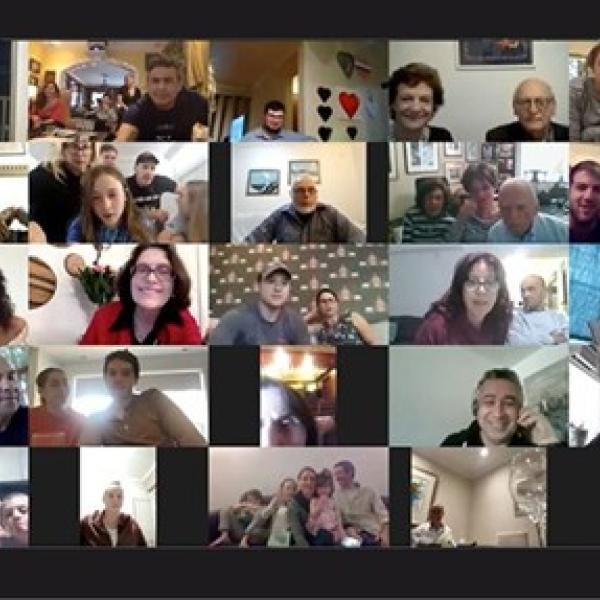
"Instead of giving in to disappointment that we couldn’t host our own boisterous and house-packed seders, we seized the opportunity to convert a worldwide shelter-in-place ordinance into a family reunion. Geographically distanced, many of us have never shared this ritual night together, and even more of us have never used a video social conferencing service.
So with buoyed spirits, we gathered online, read from our hagaddas in front of cameras, and used devices we usually disconnect from, as our lifeline to connection itself.
How do we make meaning together when we’re physically separated? How do we not just live through this pandemic, but how will it change us? These were a few questions we brought to our virtual Passover table conversation.
Our seder began with candlelighting, a collective attempt to bring light in a dark time. We read the ancient story of Exodus and considered what this moment asks of us, as the Israelites asked themselves. We asked the four questions in multiple languages. We looked back to look forward, listening to the meaning of Pesach from a Syrian refugee who inspired empathy and compassion for our shared humanity and made the fundamental idea in the Passover story of “welcoming the stranger” all the more visceral and real.
We marked the unusual constraints and mixed emotions of hosting a Passover gathering in the midst of a global pandemic and also gave ourselves permission to be joyful; delighting in five year-old Liam Shmuel’s lego creation of our ancestors' epic crossing of the Sea of Reeds and dancing with absolute freedom to “A Tribe of Brothers and Sisters” (Shevet Achim VeAchiyot) performed by some of Israel’s most popular singers with a message of unity and love for Israel.
On this Passover like no other, age–old questions about the holiday never felt more poignant, and our Menasce family and friends never felt more grateful for being able to unite, heal, and bond over one big beautiful global seder!"
- Menasce Family
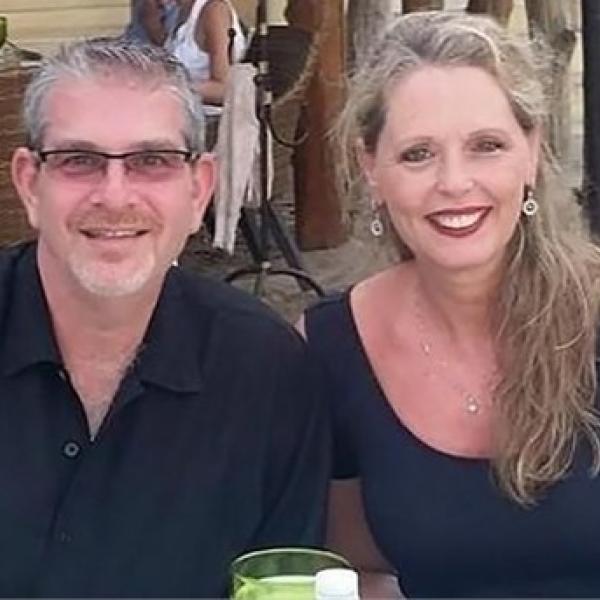
Janice Odette Jacobs
"Tonight is the Eve of when the bottom fell out of my life. This day exactly a year ago, my husband Andy told me he couldn't breathe...We called the doctor, and they told us (Justyn, our daughter, and I) to give him warm broth and tea. We couldn't get his fever below 103. He managed through the night, but in the morning, he was worse. I drove him to our doctor's satellite office in Bothell, WA. In the time it took me to use the bathroom, he was on a stretcher heading for the hospital. They took him to Overlake Hospital in Bellevue, WA, where he was doing a little better and then not. The ER Doc called me and said they were admitting him. The admitting Doc said his Oxygen levels were too low, and he sent him to Intensive Care, and within 10 minutes, he was intubated. Due to his intubation, he was placed in a coma to assist with his breathing. I was unable to talk to or see him. He had bilateral Covid Pneumonia...Viral, not bacterial, infection in both of his lungs.
So what did I go through during this time: pain, intolerable pain. Was I the one who gave it to him? Was I responsible for his illness? The guilt, the insurmountable guilt, was more than I could take, and I didn't know how to forgive myself. I was on my knees at night, praying as I had never prayed before. There was no routine...My days were filled with crying and waiting...endless periods of waiting for a nurse or a doctor to call with any information. I wanted to talk to no one else except my children and my sister-in-law, who is a doctor and was on the front lines in St. Louis. I learned more about Covid 19 than my Doctor or most Doctors knew. Not an education I wanted. I would never ever wish this on anyone. PTSD is very real!
Andy, on the other hand, was oblivious to anything going on. The Medical Staff at Overlake gave him pretty much any drug they thought that would remotely help. On day 8, the first night of Passover (his absolute favorite holiday), he was removed from the ventilator; was it a Passover miracle? It felt like one to us. However, he was not out of the woods, as now he had bilateral bacterial pneumonia. He was completely out of it and didn't know where he was or what time it was. He hated the food. We thought the light was beginning to glimmer, but no...he took another turn for the worse. This was the second time we almost lost him. He had the entire world praying for him...Someone even cleared his chakras. We were desperate. I would have done pretty much anything to get him back.
Day 15, he was released from the hospital without any fanfare, just the nurses and Andy, and I sobbing in each other's arms, not really understanding what the other had been through. A year has passed, and my anger against non-compliant people is still palpable a year later. The amount of stupidity I witness on a daily basis raises more questions than answers. They do not know me or my story; they have not lived through what I have lived through. Do they not get it?
We are now vaccinated and breathing (literally) a little lighter.
Andy donated Convalescent Plasma 7 times, and we have tried to give back and support COVID survivors when we can.
The road has been incredibly long and fraught with so many long-hauler side effects that are way too long to mention. The view is so different on this side. My lessons were too numerous to list. It is sufficient to say the year has been a long one that culminated in Andy at the head of our Passover table, leading the Seder in the place he was meant to be, surrounded by his family.
Love to all of the people who supported me along the way and those still with us on our unending journey through this pandemic."
- Janice Odette Jacobs
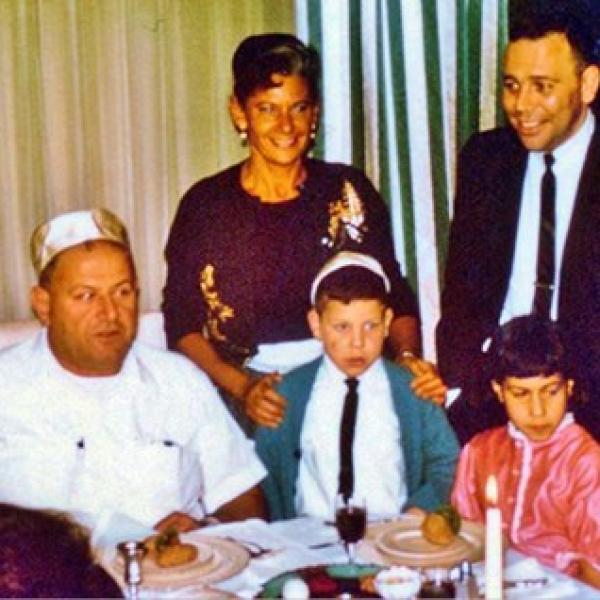
Passovers Past by Joyce Dickhaut
"The 2020 Passover has gone without our usual celebration due to the pandemic, but it brought back memories of many other Passovers. First at my grandparents', led by my grandfather in Hebrew. The seder seemed endless. Then, for many years, led by my father, which were much more fun and mostly not in Hebrew because Daddy, I think, forgot all his Hebrew after his Bar Mitzvah. After Mother was gone, my sister and I often alternated the holiday, sharing the family Haggadahs and inviting friends as well as family. For a non-observant Jew, I used to throw a pretty good Passover. The Passovers I describe here are from many years ago, and many of the participants are no longer with us.
As I remember, even back to my childhood, I’m not sure whether it was the food, the company of loved ones, or the Passover story that was the most important ingredient. Our Passovers after Grandpa were not really strictly religious events. Oh, we did perform the rituals. We drank the wine when directed and partook of little bites of the symbolic foods such as matzoh, parsley, haroset (a yummy mixture of chopped apples, nuts, and wine), and other items. And we tried not to skip too many pages of the Haggadah, the book that tells the story of the exodus of Moses and the Israelites. But our family had settled into its own set of customs as predictable as the sunset that marks the annual starting point of each Passover.
Just as my mother did, my table was always the same: snowy starched linens, my best china, candles, and daffodils as a tribute to spring. And our pale blue hard-cover Haggadah books rested at each place. My daughter in Florida now has possession of those books. The menu never deviated: gefilte fish with ruby red jalapeno-hot horseradish, steaming chicken soup with fluffy white matzoh balls, hard- boiled eggs, oven-roasted potatoes, asparagus, chicken or brisket, matzo, and wine…. lots and lots of sweet Passover wine.
Our table was a little unusual because the non-Jews typically outnumbered the Jewish participants. One year at my house, the group consisted of my sister Linda, the only one at the table who could actually read Hebrew, her best girlfriend Eleanor, and me, all Jewish. However, our husbands were not; they were of German, Swedish, and Irish descent. We also invited our Catholic neighbors, who delighted in participating in rituals of any sort, especially when food was involved. My son and his non-Jewish wife completed the table. Looking back on the group, it is sad to remember that both of my neighbors, as well as my husband, are now gone, but the memories of the holiday are still vivid.
Remembering many of those evenings, it was the very sameness that we loved about the holiday. We were like a stock company of actors who were well-rehearsed and knew all our lines and cues. We could rely on Eleanor to drink a little too much wine and giggle incessantly, which exasperated Sean, her Irish Catholic husband, who took his religion as seriously as the Pope. At certain passages, we all got a little nostalgic and reminisced about Mother and for Daddy, who used to lead our seder with mispronounced words and his own jokes about Moses and the desert. I knew my husband would invariably trip over the word affliction, mispronouncing it “affection” just as Daddy used to do. The first year my husband led the seder in English, of course, I had written out phonetically the blessing over the wine so he could pronounce it in Hebrew. As he did that, my sister’s jaw dropped, and she asked, “Where did you learn to do that?” which got a lot of laughs. I was usually hungry and had serving dinner on my mind, and was always paging ahead in the book, asking if we could skip certain sections, urging us to the place where the book directs: “The meal is served.” I can even remember that it was on page 84.
Part of my nostalgia had to do with the actual Haggadah books, which were handed down after Daddy died. The publication date printed boldly on the title page, is 1942. The book’s narrative is supposed to describe events that happened in Egypt 5,000 years ago. However, our version alludes to other Jews who had been trying to escape the Pharaoh’s modern counterpart, Hitler. Some passages even hint at the conditions in Europe at the very time this book was printed in 1942. It indirectly refers to the Jews who were hiding, trying to escape their Nazi persecutors, reliving what their ancestors must have experienced thousands of years before.
The book’s foreword states, “The age-old struggle between those who cherish freedom and those who would deny it to others has become more embittered than ever. In that struggle, the Jews are greatly involved, and they have a great stake in the ultimate cause of freedom”. The author didn’t realize in 1942 just how great that stake would ultimately become.
While it is difficult for me to relate to biblical characters escaping from an Egyptian oppressor, my own outlook takes a different perspective when I consider this story to people I know now who are still living. In fact, I have several friends in Bellevue, including two of the women I walk with every morning, who fled Europe as children before the Holocaust, and who escaped the horrors of Dachau or Buchenwald. The Passover story provides an added dimension when I realize that I have the good fortune to live in a place symbolically comparable to the promised land that Moses sought, and that my family celebrates the Passover warm, well-fed, and most important, free.
We finish our meal and continue with the readings. We approach the end of the seder and drink, as directed, that last sip of wine. Our Haggadah says, “We have rededicated ourselves to the cause of man’s freedom from oppression. May we celebrate it next year in joy, in peace, and in freedom.” And in my heart today, I echo that sentiment and include the rest of those suffering in today’s world. The quaint book with its whimsical illustrations of biblical scenes concludes with a distinctly secular but very patriotic finish. Printed on the last page are the familiar words of the anthem America, with the last phrase “Let freedom ring” in bold print. This is the final note of our Passover seder and one we never skip, joining our voices to sing this song celebrating our precious freedom."
- Joyce Dickhaut
Jewish Organizations and Synagogue Stories
Below are stories submitted by Jewish community organizations and synagogues sharing how they continued to operate and support their communities during COVID. We are grateful that they shared how they kept their organizations running and their communities connected during such a challenging time. Scroll through to explore their stories and hear their experiences in their own words.

Seattle Jewish Community Center
"In an almost biblical and cyclical way, Purim 2021 marked the one-year impact of COVID-19, as it was Purim 2020 that was so abruptly jolted by COVID-19. The first time around, in 2020, we quickly transitioned to a “Purim2GO” model, where family fun kits were available for pick-up around the region. By Purim 2021, the SJCC team designed a family Purim scavenger hunt to commemorate the holiday.
In keeping with the tradition of telling the story and honoring how Esther bravely exposed her previously hidden Jewish heritage to her husband, SJCC families loaded into their cars and explored Mercer Island's amazing parks and public spaces while learning the story of Purim. The SJCC created eight clues, which told of Esther's heroic deed of saving the Jews from the evil Haman— BOOO!. Of course, the hunt ended with hamentashen and prizes for the whole family!
One participating family said, “The Purim Scavenger Hunt was such a fun way to get outside with our kids (ages 3&4) during COVID. It was great having so many locations where the kids 2 could run around and play, especially in their costumes! We enjoyed it as parents just as much as they did.”
Like so many other elements of this pandemic, the shift from the J’s 40+ year Purim carnival tradition forced us to adapt, and in that shift, we found new and meaningful ways to bring our heritage to life. After all, the story of triumph over evil can be told and celebrated in so many ways, and we did exactly that! Attached is the poster from the event, as well as a sample of the clues and parent guide."
- SJCC Team
Temple De Hirsch Sinai
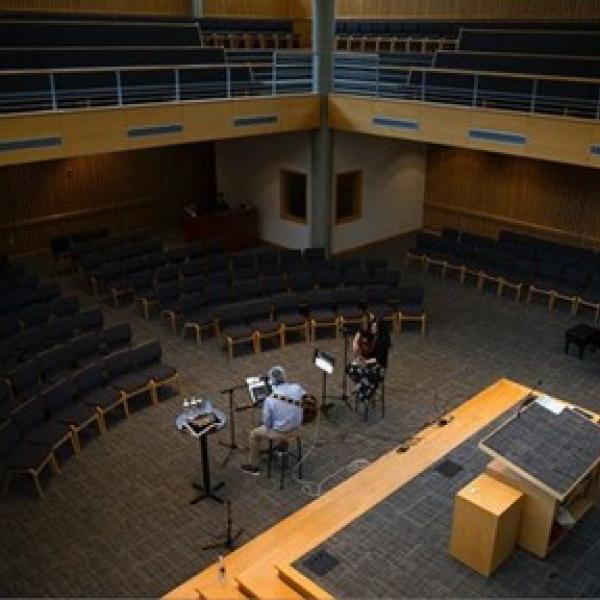
"The Temple De Hirsch Sinai community responded to the current crisis in timely, substantive, and inspiring ways. We moved to streamed Shabbat services early on, garnering High Holiday numbers of "attendees." Through the diligent work of our Ed Team, we moved Religion School and Hebrew School online. Within the first week, the Board, our Caring Community Committee, and a growing army of volunteers reached out to the most vulnerable and isolated within our community, and informal gatherings of Temple members generated affirming opportunities to connect. Even our Jennifer Rosen Meade Preschool found unique ways for multiple daily check-ins and experiences for our young families. At a paradoxical time in which there was an acute need for community, but constraints against physical meeting, our Temple family forged impactful and enduring bonds of faith, care, and blessing."
- TDH Team
Spokane Area Jewish Family Service
"During the COVID-19 pandemic, Spokane Area Jewish Family Services has worked to provide individuals and families in need with nonperishable items from our food bank and help with rent and bills through our direct financial assistance program. We have created virtual programs to help seniors in the community feel less isolated, and we have used reassurance phone calls, phone or Zoom visits, and consultations with clients to help them meet their psychological, emotional, and practical, everyday needs. SAJFS established a community free classifieds service that people can use to donate or receive used items in good condition. The agency has coordinated no-contact pickup and delivery and has ensured donor and recipient anonymity throughout. We have witnessed many mitzvot; perhaps the most memorable are the amazing shows of support for our May 2020 virtual fundraiser and our upcoming virtual Jewish film festival (scheduled for March 2021).
I am my agency’s only staff member, so I am used to working alone in an office. I have attempted to remain connected with clients via phone and Zoom and have done minimal client transportation, observing safety protocols on the occasions I do so. I have also made sure donations to our food bank and deliveries to food bank clients are no-contact.
SAJFS has nearly eliminated in-person client visits and consultations except in unusual circumstances (and in those cases, we observe safety protocols); transformed our monthly senior luncheons and occasional PJ Library programs for kids 12 and under into virtual programs; and adapted our annual Jewish film festival to a virtual format as well."
- Neal Schindler

Cong. Beth Shalom
"From the Congregation Beth Shalom COVID Committee
As most of you know, Governor Inslee issued new regulations in response to the rising cases of COVID19 in Washington State. In addition, we have been in touch with the King County Public Health Officer in charge of faith-based organizations. Based on the new restrictions and the King County recommendations, the COVID committee is implementing the following changes:
1) Services will be limited to 50 people (we are permitted to have up to 150 people; however, out of an abundance of caution, we are choosing to keep the numbers small)
2) We are removing some of the chairs, so all pods will be at least 10 feet apart. Again, this is beyond the 6 feet required but we are being extra-cautious.
3) Communal singing, even masked, is no longer allowed by Governor Inslee. This does not actually change our policy since we had not been allowing communal singing.
4) Per King County guidelines, everyone, including service leaders, must remain masked at all times.
5) It is highly recommended that people bring their own Kippot, Tallitot, Siddurim, and Humashim. For people who don't have their own Siddur and Humash, we will provide ones labeled with your name that you will leave on a table in the sanctuary and reuse each time you attend services.
6) We were planning on hosting an outdoor Hanukkah program that we unfortunately will have to cancel, given the cap of 5 people on outdoor socializing. There will still be opportunities to celebrate Hanukkah together on Zoom, as well as a drive-through sufganiyot (jelly donut) opportunity! (stay tuned)
7) No indoor social programs and no outdoor social programs of more than 5 people will be held for the foreseeable future.
Thank you for your understanding."
- The COVID Committee

Congregation Ezra Bessaroth
"To my Dear Ezra Bessaroth Family,
As you are aware, due to the COVID-19 health crisis, we have made the difficult decision to close our facilities at this time. This agonizing decision has meant we are not able to come together physically to pray, to mourn, to celebrate, and specifically to wish a speedy recovery and Refuah Shelemah to the sick.
Yet we are not deterred. For the first time, we opened our doors virtually to the entire community. We have services 7 days a week, where the mourners can say the Kaddish. We have a weekly Perasha class with Rabbi Benzaquen and inspiring guest lectures. We have Meldados and a special service for the sick every Wednesday night. We have welcomed back our community members from all over the country. We find comfort in seeing familiar faces and making light conversation. We find silver linings at every turn.
We look forward to the day we are all together. I firmly believe we will persevere and return from this crisis stronger than ever. You have our support, and even at a distance, our thoughts and our hearts are with you. May Ha’Shem protect us all and give us the strength to withstand the difficulties that we each may face in the time ahead. May our prayers serve as a zechut (merit) for those who are ill and to ward off this pandemic.
Moadim L'Simcha!"
- Cong. Ezra Bessaroth Team
Hadassah
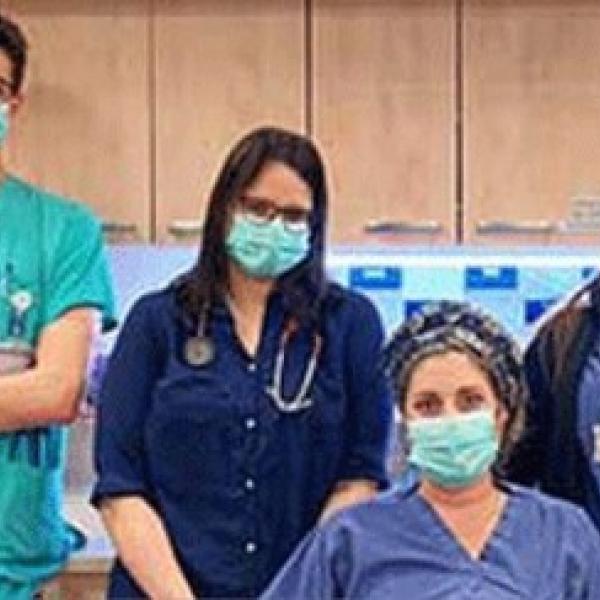
"Dear Hadassah Members,
We are all of us carrying around so much uncertainty every day. I could no longer put off making the difficult decision about our Gala Fundraiser. When I put the question to a vote at our recent virtual Board Meeting—whether to keep, postpone, or cancel the Gala Fundraiser— the decision was overwhelmingly to postpone it until next spring. No one knows what the future will bring, but our Gala is always such a simcha for the entire community that it will have a better chance to be that joyful celebration if we wait. Thank you for putting your trust in us.
In light of the pandemic, long-time Hadassah life member, Joy Pocasangre, wrote me, “The best part …is that Hadassah Hospitals are fully functioning. We can be proud of what Hadassah has given Israel and the world.” And Rhoda Smolow, our new National President, shares, “We can once again stand proudly to say that our hospital is stepping up to offer what no other hospital can: a separate building, our iconic round building, to house patients suffering from COVID-19.” For the full Message, click here
A Happy and Healthy Passover."
- Ettie

Hebrew Free Loan Association
"COVID-19 has affected our Jewish community both financially and emotionally. The Hebrew Free Loan Association (HFLA) has responded to both those crises by offering cash assistance in the form of interest-free loans to individuals facing financial hardship, thus alleviating the stress of "how am I going to take care of my children, and pay my bills," and by providing the immediate financial support individuals need.
In response to the crisis, our board immediately responded by reducing barriers for those in immediate stress. The board created a new assistance program that offered loans of $750 and eliminated the requirement for having guarantors. Additionally, HFLA supports deferred repayments and repayment dates for families that currently have outstanding loans and are struggling.
HFLA has been able to provide loans to restaurants, families with children, and those who have been furloughed. We are finding that as the world is opening up, and people have to move on with their lives, the crisis is getting more intense. People need funds to resume life. Hebrew Free Loan Association of Washington State is here to support our local Jewish community in meeting their financial obligations until they are able to do so on their own."
- Hebrew Free Loan Association Team
Jewish Federation of Greater Seattle
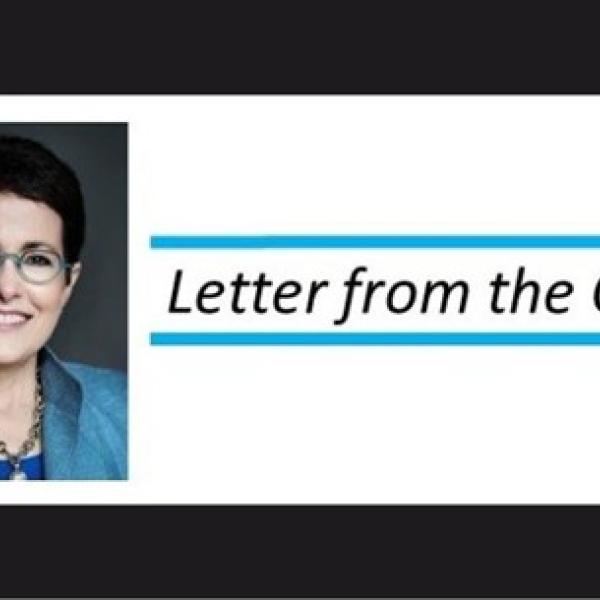
"The Jewish Federation of Greater Seattle is saddened and outraged by the death of George Floyd, a 46-year-old unarmed black man, earlier this week in Minneapolis. A white law enforcement officer held his knee to Floyd’s neck for over eight minutes. Floyd gasped for air and repeatedly pleaded for his life while three other officers did nothing.
We protest George Floyd’s tragic death, yet one more in a seemingly endless string of violence perpetrated against black people in our country today. We must also remember, protest, and say the names of the other victims of recent senseless killings:
- Dreasjon (Sean) Reed, a 21-year-old from Indianapolis who died after being shot at least eight times by a police officer (May 6, 2020).
- Breonna Taylor, a 26-year-old who was shot eight times by Louisville Metro Police Department officers who entered her apartment while serving a "no-knock warrant" (March 13, 2020).
- Ahmaud Arbery, a 25-year-old and who, while jogging, was chased down, shot, and killed by a retired police officer and his son in Brunswick, Georgia (Feb. 23, 2020).
Judaism is clear about our obligation to not stand idly by in the face of injustice. Rabbi Abraham Joshua Heschel said, “In a free society, only some may be guilty, but all are responsible.” Peaceful and lawful protest shines a light on the injustice, whereas violent protest only causes harm and must be strongly condemned. We must redouble our efforts to combat racial bias and violence, the structural and systemic racism that continues to deprive black Americans of justice and equal opportunity, and the apathy that allows too many to turn a blind eye.
The Jewish Federation is proud to advocate for racial equity in our criminal justice, education, and human services systems. We will strive to raise up the voices and center the experiences of people of color, including Jews of color, in this work. We do this to stand in solidarity with those who are marginalized, and to honor those who stand tall and are resilient in the face of oppression. We ask the whole of the Jewish community to join with us.
In Judaism, through the value of B’Tselem Elokim, we are called to see and protect the life and dignity of every person. Our job will not be done until the mothers and fathers of black and brown children across our country are treated justly and equitably, and until these parents have peace of mind that their children can run, play, and work in safety and freedom."
- Nancy B. Greer, Federation's President & CEO
Temple Beth El
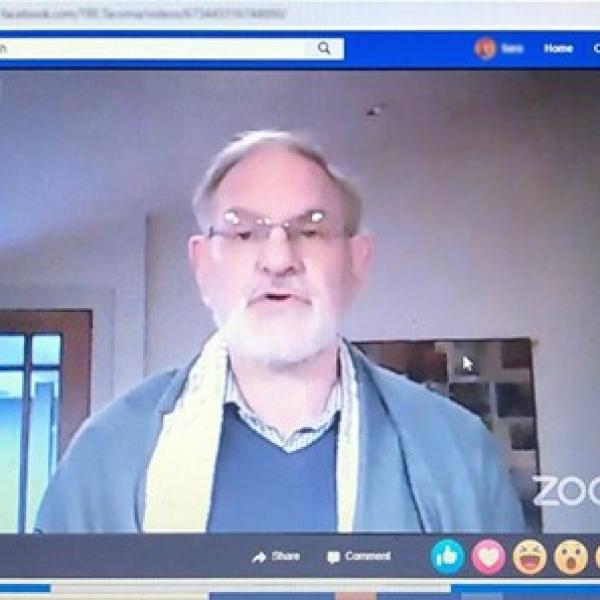
"The Four Children in the time of COVID19
The four children of the Passover seder provide us with a paradigm for reflecting on four responses to the Coronavirus pandemic.
Those who are wise ask: “What is the best way that we can respond to COVID19?
To them we respond, “We look to the scientists and experts to guide us in our response to COVID19 and follow the directives issued by government officials to shelter in place, practice social distancing, and wash our hands.
Those who are wicked ask: What is this hoax that you have unleashed upon us?
By dividing between “you” and “us,” those who are wicked ignore the fact that we are all in this together. By calling this pandemic a hoax, those who are wicked have encouraged many to ignore the serious warnings and not follow the guidelines of experts. They have violated the commandment, “You shall not place a stumbling block before the blind” (Leviticus 19:14).
Those who are simple ask: What is this?
To them, we respond with the basic information about COVID19 and the important precautions we should all take to prevent its spread, the most important of which is shelter in place.
And to those who are unable to ask, who are so overwhelmed by it all, we must begin by acknowledging how difficult this situation is for all of us and that we are all in this together.
Those who are wise, those who are wicked, those who are simple, and those who are unable to ask are all in it together. COVID19 does not distinguish between those who are wise and those who are wicked, between those who are simple and those who are not able to ask; it does not make a distinction based upon gender or age or religious or ethnic identity or between rich and poor, citizen and non-citizen. We may each ask different questions, each react in different ways, but we are all in it together."
- Rabbi Kadden
The Samis Foundation
"The Samis Foundation gives to the Jewish communities of Washington State and Israel, supporting Jewish day schools, overnight summer camps, teen Israel experiences, youth enrichment and engagement programs, and initiatives in Israel. Samis responded to COVID-19 with immediate actions, including financial and emotional support to community partners and the Jewish community.
In a first step, the foundation offered $10,000 to support technology needs for seven of Seattle’s Jewish day schools as they pivoted to virtual learning. In an effort to better understand how foundation grantees were adjusting their operations and serving their constituents, and to provide reassurance and address initial concerns, foundation staff personally contacted each grantee via email, phone, and Zoom and sent letters outlining supportive measures taken to ease grantee stress and reaffirm the foundation’s commitment to their work.
To address emergent financial needs, in particular for at-risk populations, Foundation trustees authorized an initial set of emergency and disaster relief grants totaling more than $100,000 to local organizations in Seattle, Israel, and internationally. The foundation is proud to continue supporting our partners and the Jewish community as we witness astounding levels of creativity, innovation, and collaboration under unprecedented circumstances."
- Samis Foundation Team
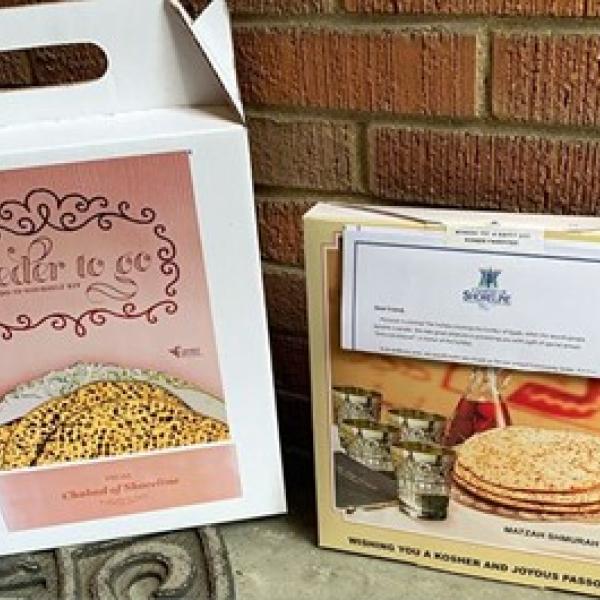
Chabad of Shoreline
"At Chabad of Shoreline, we set up a Covid19 relief website to facilitate support and volunteer opportunities to anyone who’s seeking to help and to help those who need help in any way. Click here for the link.
Additionally, with Passover around the corner with no way for many to attend a community Seder, leaving many to have to make their own Pesach Seders at home for the very first time (a potentially overwhelming experience), we delivered many DIY (Do It Yourself) Seder kits that included the necessary Pesach Seder items and foods with easy instructions and a detailed guide of how to make your own Seder. We also created a webpage on our website with tons of Pesach in quarantine resources. Click here to view."
- Chabad of Shoreline Team
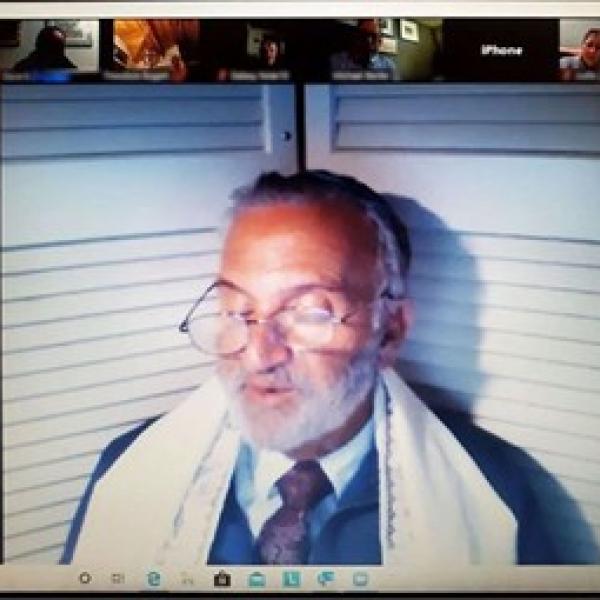
Bet Chaverim
"Our congregation is determined to protect our family in all ways possible. At the same time, we are encouraging our members to maintain relationships through Facebook, email, telephone, and FaceTime.
Our plans have changed, but we are determined to go ahead with the education goals that we have set. We have our class dates. With the assistance of our computer-savvy members, the classes are going to be held online. We are excited to proceed with classes as planned.
We hope and pray that everyone you know and love stays in good health.
This will be a time to remember for decades to come-I know we will emerge stronger as individuals and a community."
- Rabbi Mirel
Jewish Family Service Seattle
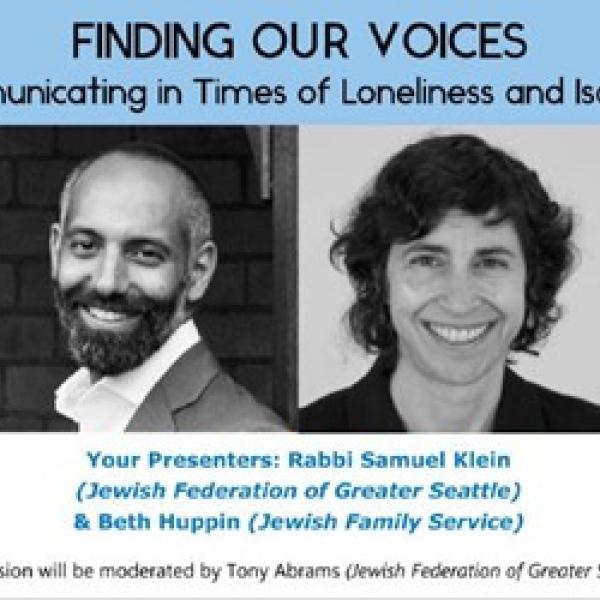
"Jewish Family Services of Seattle partnered with the Jewish Federation of Greater Seattle to host an online community-wide learning session called "Finding Our Voices: Communicating in Times of Loneliness & Isolation." The presentation focused on the Passover Haggadah and the act of telling stories and staying connected and was led by Beth Huppin, Director of Project Kavod/Dignity at Jewish Family Service, and Rabbi Samuel Klein, Director of Jewish Engagement, Jewish Federation of Greater Seattle.
The first remote learning session received more than 150 individual participants who shared comments and asked questions using the chat feature in Zoom."
- Jewish Family Services Team

Stroum Jewish Community Center
The Stroum Jewish Community Center launched "Virtual SJCC" to provide the community with classes and activities, from personal training to book reading and arts and crafts, as well as to maintain a list of available Jewish-themed media from around the internet.
- SJCC Team
Congregation Kol Ami
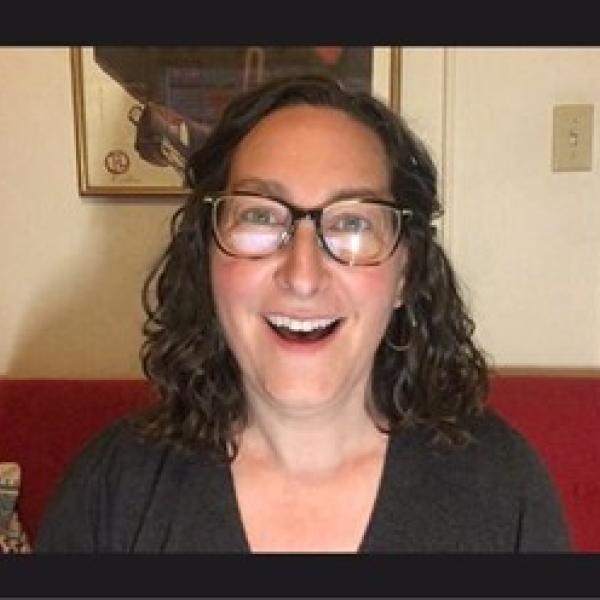
Congregation Kol Ami, Vancouver, Washington, always has a communal second night seder. One of the highlights is always Chad Gadya, where different people (kids and adults) volunteer to come to the front and make the sound of one of the characters. This year, because of the requirement to stay separated, members sent in videos of themselves ahead of time, which we put together into our Epic Chad Gadya movie.
- Kol Ami Team
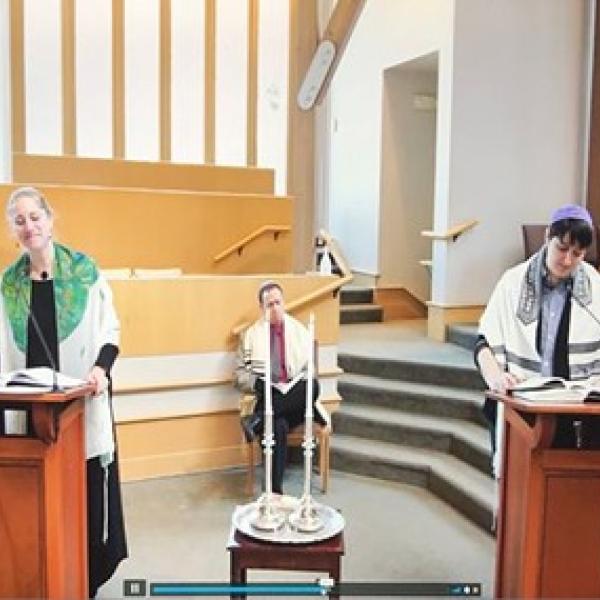
Temple Beth Am
Temple Beth Am provided a Zoom-streamed Kabbalat Shabbat on March 20, 2020.
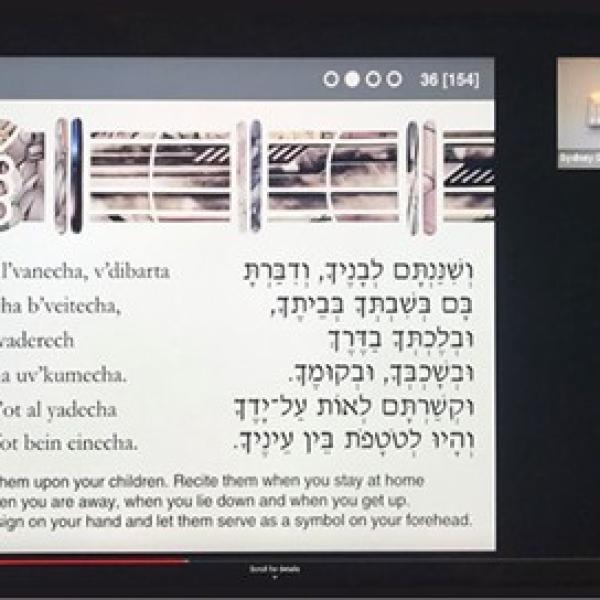
Temple B'nai Torah
Temple B'nai Torah streamed its Kabbalat Shabbat services with the siddur as a slideshow on March 20, 2020.
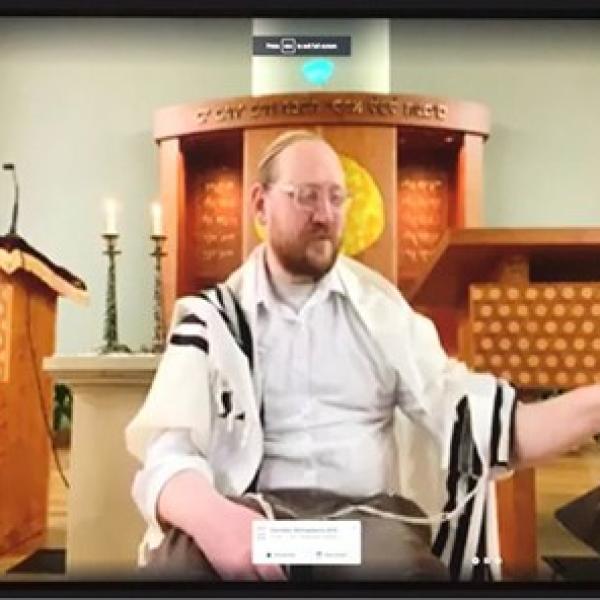
Temple Beth Hatfiloh
Temple Beth Hatfiloh and Rabbi Seth Goldstein are conducting streaming Shabbat Services beginning with Kabbalat Shabbat on March 20, 2020.
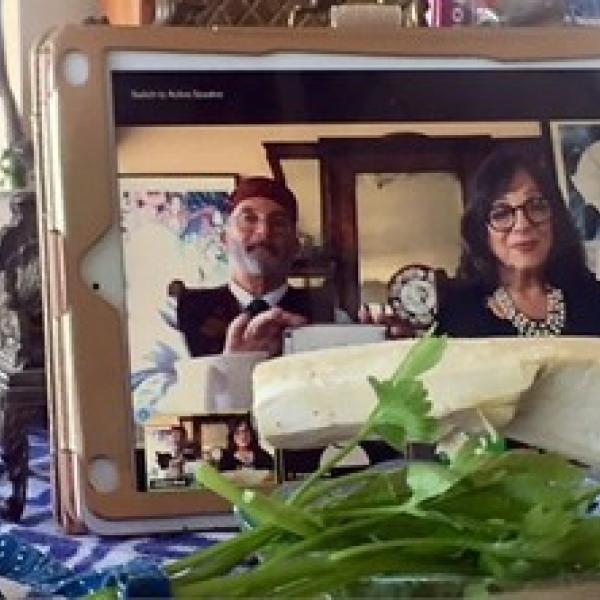
American Jewish Committee
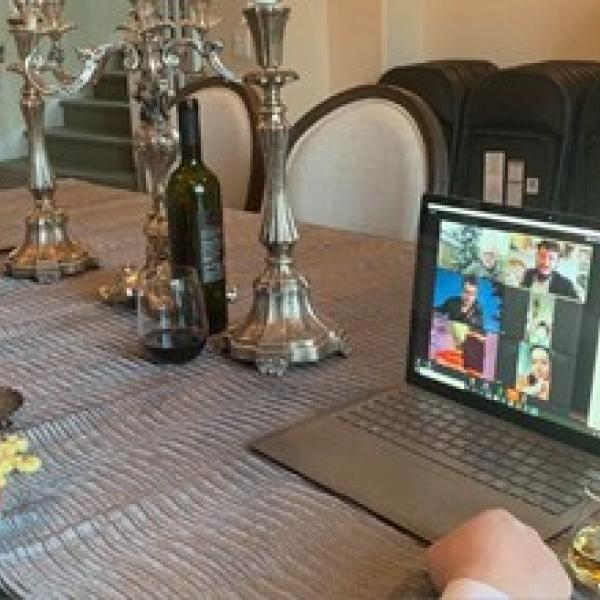
Rabbi James and Julie Mirel led the Zoom Seder for the Seattle Chapter of the American Jewish Committee during the COVID19 isolation on April 9, 2020. Over 100 people ‘attended’ via the internet.
Chabad of Queen Anne-Magnolia
Rabbi Shnai Levitin is leading the weekly torah class, Parsha On Tap, virtually with members of the community on March 26, 2020.

Hillel at the University of Washington
"Seders To Go." With the campus closed for the rest of the school year, the need for social distancing, and the Governor's Stay Home order issued 03-23-2020, Hillel at the University of Washington offers kosher Pesach meals to go.
- Hillel UW
Healthcare Stories
Below are stories submitted by frontline healthcare workers who served during the COVID-19 pandemic, caring for patients while working to keep their communities, families, and themselves safe. We are deeply grateful for their dedication and honored to share their experiences—Scroll through to explore their stories and hear their experiences in their own words.
Dr. Henry Kaplan
"The pandemic hit just as I was changing from clinical practice to full-time cancer research. This has afforded me the opportunity to see the incredible job everyone has been doing in both areas. On the clinical side, everyone from physicians to nurses, to technicians, secretaries, security, administration, and housekeeping has adapted to all kinds of changes while subjecting themselves to risk to make it safer for both our staff and our patients to continue to receive care in the scariest of times. On the research side, everyone has been all in from day one to work on clinical trials to try to come up with effective treatments for this nasty bug. Multiple institutions have banded together to get the studies done as quickly as possible. The community has donated material and money to help us to do this. All of this has truly been a total community effort."
- Dr. Henry Kaplan
Dr. Elizabeth Kaplan
"The pandemic of 2020 has brought me back to the original foundation of doctoring. In the face of a new virus about which very little is known, I have been reminded of how important listening, human connection, empathy, and compassion are as I work as a physician. It is these values that help me support my patients when they are scared and feel alone. I witness countless mitzvahs daily as I watch my colleagues in nursing, environmental services, administration, and fellow doctors bravely face unknown risks to take loving care of patients. I also see our community supporting health care workers, small businesses, and each other throughout this great challenge. In such a frightening time that is causing so much suffering, it is these moments of kindness that help me move forward each day."
- Dr. Elizabeth Kaplan
Dr. Garrett Scott Hyman
I run a small two-doctor medical clinic in Bellevue, WA. We have 5-6 other team members supporting the two physicians. We typically see close to 60 patients per week per physician = > 100 patient encounters per week.
We are non-surgical sports medicine and spinal specialists. We see nearly all ages, ~age 9 to 99, folks of all activity levels -- but we do screen and require our patients to have some physical activity goal in mind. We collaborate with many other providers in the community, particularly with orthopedic surgeons, neurosurgeons, primary care providers, physical therapists, chiropractors, massage therapists, and acupuncturists. We specialize in "Keeping People Active." We do so by precisely diagnosing a problem and performing targeted injection procedures to spur healing in those who are not responding to more conservative treatments.
The novel coronavirus that causes the COVID-19 illness has uprooted the lives of everyone I know. Some more than others. And I live in the beautiful bubble of Mercer Island, and so am shielded from observing some of the more dire consequences caused by the economic shutdown. None of my friends have lost their jobs as of yet, and everyone enjoys home and food security. We stay home with our families, and knock on wood, everyone is healthy. I know no one personally infected by the virus. It really doesn't feel personal at all. All I know is I don't have to sit in traffic, I get to work from home, and when I take breaks, I see my wife and children more. As my work partner has said, this is the most pleasant pandemic he could imagine.
What changes have I made in everyday life?
I am sleeping a little later, and probably most often going to bed later. I never used to see my kids before work, as I used to leave before they woke. Now I see them, at least my younger ones, by 9 am. That's nice. I even get a morning hug once in a while. I eat more. Before this situation, I skipped breakfast and lunch on most days. Now I eat 3 squares. I've gained ~5 pounds. I exercise less and sit more. I'm at my computer or on a device more. I watch more television. We usually watch a show each evening.
I don't go to work, but I might be working more hours because now I'm trying to save my business. I've learned much more recently about my business out of necessity -- I've had to focus on cutting costs, and taking out a government Paycheck Protection Program (PPP) loan via the Small Business Administration. I experienced more stress than usual late March through the end of April, worrying daily about how I would keep my business going and wondering if I'd receive a loan.
How am I staying connected with friends and family?
We're doing fairly well here, with frequent phone calls, FaceTime calls, and Zoom calls. Like all the other Jews I know, we had a 'Zeder' or Zoom seder. We've celebrated birthdays via Zoom. If anything, I've had more contact with family and friends since this COVID-19 crisis.
What mitzvahs have I witnessed during this time?
Clearly, one of the greatest mitzvahs I've observed has been watching physicians and healthcare teams bravely diving into danger as my colleagues have treated COVID-19 patients. And then it has been so special to watch friends and non-medical colleagues making masks and personal protective equipment for local hospitals and healthcare providers.
How am I handling the need to stay home, maintain social distancing, and other restrictions in daily life?
Staying home is a blend of easy and hard. I certainly miss others -- friends, shop owners, people watching in restaurants. I am also rather enjoying my time at home. I'm getting used to this. The restrictions are most frustrating for me when I want to go to a park or to a gym for exercise, to a shopping mall, or to a restaurant or coffee shop.
What have I learned from this experience?
I've learned how to practice telemedicine. I actually was the sole physician participating in a Washington State Medical Association (WSMA) webinar describing my experience with telemedicine. I'll copy my notes to the end of this document in case anyone might find them interesting.
How has my career been altered?
Good question. I am not clear if my clinic will ever be the same as before. It's entirely possible that the future will involve a combination of telemedicine and in-person medicine. It's possible I will not find it tenable to keep my private practice. For now, as of May 21, 2020, I am hopeful that we will be seeing patients as per normal by the end of the summer.
If I am still working in the hospitals right now, what has changed?
I do not practice hospital medicine, but I do perform spinal injections at Overlake. The Overlake Surgery Center is closed. We think it will open again so that I can perform procedures sometime in June.
A socially distanced bear hug,
- Garrett S. Hyman, MD, MPH
Education Stories
Below are stories submitted by students who experienced the education system during COVID. We are grateful that they shared what it was like to learn and live through such an unprecedented time. Scroll through to explore their stories and hear their experiences in their own words.
Alyssa Boden
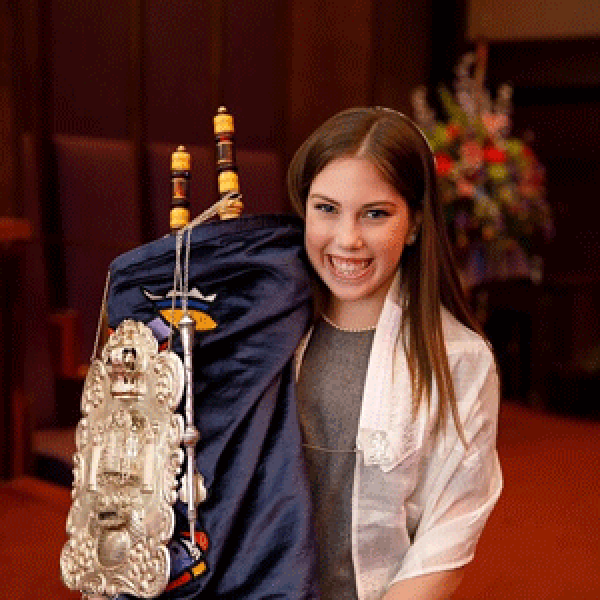
"My name is Alyssa Boden, and I am an 8th grader at Seattle Academy of Arts and Sciences (SAAS). During this global crisis, I am doing my classwork remotely and focusing on staying safe and healthy. I love playing sports, including soccer, basketball, tennis, and lacrosse. I am working hard to stay active by walking, and I am hoping the weather will change soon so I can get outside more and play more sports. I am spending quality time with my family and friends by cooking, playing games, and FaceTiming. I am learning the concept of change and how to step back and appreciate the things I have. As my parents have said to me over the years, I am taking the time to stop and smell the roses. I think before this pandemic, I didn’t think about the importance of my health and those that I love. The hardest thing I am facing right now is the possibility of not going to summer camp. It’s my home away from home and the most special place to me. I look forward to seeing all my friends and am holding onto a glimmer of hope that camp will happen this summer, even if in a different capacity."
- Alyssa Boden

Hannah Boden
"My name is Hannah Boden, and I am a Junior at Seattle Academy of Arts and Sciences (SAAS). I am an active tennis player and volunteer my time with several organizations focusing on advocating for people’s rights. Right now, I am learning remotely, and while at home, I am trying new responsibilities like cooking, organizing, and cleaning. We are experiencing a difficult time in our lives, being confined to our home, and I am also taking the time to reflect on the life I had prior to this virus and thinking about what the future holds. Since I am a junior, much of this year has been focused on grades, extracurricular activities, studying for standardized testing, and college prep work. All of these parts of my life have been impacted, and I am learning that change can happen at any time. I am finding that being resilient and adapting to an ever-changing environment is a lifelong skill. My biggest disappointment is that my 9-week culmination trip with my camp friends to Poland and Israel may not happen. While I am disappointed, I am cherishing the time I can spend with my family, FaceTiming with my friends, and thinking about the important things in life. Life has slowed down with minimal schedules, and having this time has made me appreciate the beauty of the outdoors, my relationships, and the direction I will take in the future."
- Hannah Boden
Sydney Linkon
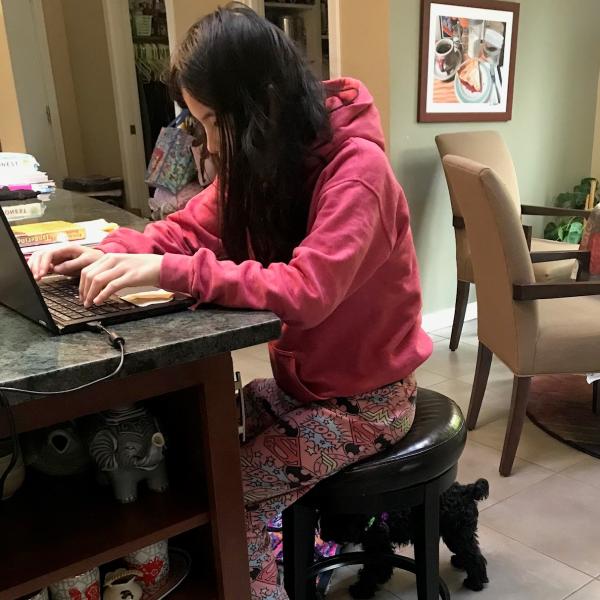
"Hi, my name is Sydney Linkon. Now that I am restricted to our home, I have school online. It's kind of cool to go to the kitchen in my pajamas and have school online, but I do miss seeing my friends. I started doing more things around the house and cleaning out my room. I made a bag or two for donations.
I've been keeping busy reading, playing video games, and getting outside to walk my dog, Molly. I am doing some fun things with my family, like completing a puzzle and doing some cooking.
We were going to travel to see family over my Spring Break, but instead we either FaceTime or Zoom each other to stay in touch."
- Sydney Linkon
Sydney Logan Samuels
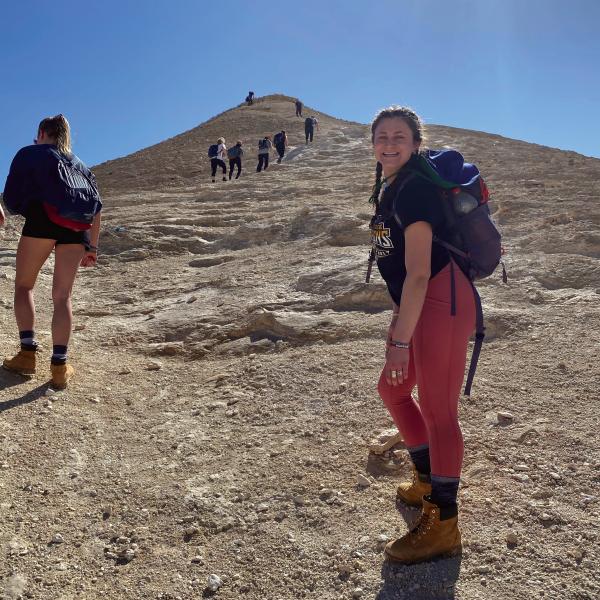
"Starting my story with everything going on, I was in Israel. I was on the Alexander Muss program, and I was supposed to be gone for four months till the end of May. My journey in Israel ended on March 15th as all teens on semester abroad programs were flown back, thanks to JNF (Jewish National Fund). By the last day I was in Israel, they had the rule in place for no more than 10 people in a room. It was unsafe for us to be there; we all lived in close proximity, and we could not risk one of us getting it on our campus. I was extremely sad to end my amazing experience as we were almost halfway through. I am currently home, keeping up with online school with Alexander Muss over Zoom.
What I have learned from this experience is to value each and every day because you really do not know what the next day will bring. My program was supposed to go to Poland, and it got canceled towards the beginning of our experience; it slowly started to affect activities and places we were supposed to go to. Since I have been home, I keep in touch with my friends from Israel every day. We are so sad to no longer be there, and I FaceTime my family members each day. I have been busy with school in the morning because we do a time that works for Pacific time, Eastern time, and Israel. It is just a weird feeling to be home, expecting to be gone for four months.
To end, leaving the most amazing experience that I have grown from and have learned so much about my Jewish Identity from was so hard. What my parents told me as I got stressed towards the end, once I heard we had to go home, was not to stress over things you can’t control. That is my story. I have experienced the amazing land of Israel and left to be home with my family during this chaotic time, living one day at a time at home."
- Sydney Logan Samuels
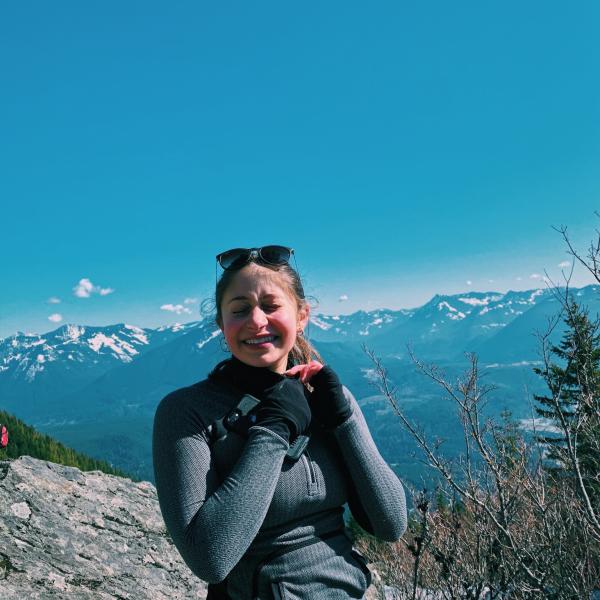
Ally Lavin
"My name is Ally Lavin, and I am a junior at Mercer Island High School.
The Coronavirus has impacted everyone in different ways, but for me, especially, it has impacted the structure of my day. I am someone who needs some amount of structure to function, so going to school every day helped with that. Now, since we are out of school, I have lost this important structure, but I am doing my best to gain it back. I try to do a few hours of schoolwork each day, then go on a jog and do some exercise, so when I come home, I can rest.
As a high school junior, the virus has also impacted my ACT and AP tests, which is a big change around the US, and it will be interesting to take part in this "experiment" with a new way to test.
This experience has taught me that we always need to be ready for change. Whether it is adapting to a new routine, having the right supplies, or finding new ways to continue old routines, we should always be prepared for change.
(I have also been hiking more and getting outside. This virus has given me a greater appreciation for the outdoors and fresh air. Because I am stuck in my house with my family 24/7, the outdoors has helped me get my own space and have a clear mind.)"
- Ally Lavin
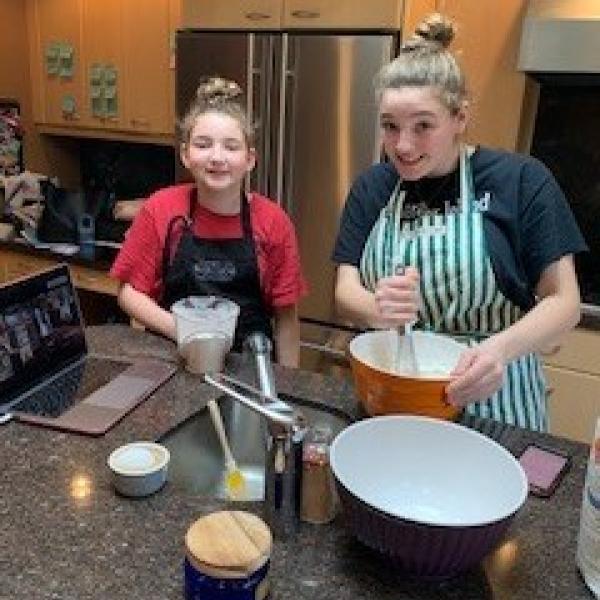
Taleah Levin
"My name is Taleah Levin, and I am a freshman studying Retail and Consumer Behavior at the University of Wisconsin-Madison. To say the least, I did not picture myself being home, studying from the comfort of my dining room table during the spring semester of my freshman year. Not only was I looking forward to advancing my studies and getting the hands-on class experience I signed up for, but I was excited to see my first Wisconsin spring and build upon all the new friendships that blossomed this year. However, I know that I am not the only one affected, not the only one who is facing challenges in this “new normal,” and I am definitely not suffering immense trouble like some people out there.
Living life in a quarantine-like state has been a change for all of us; however, it has given me the time to take up new hobbies, read, and spend time with my family, since being gone at school sometimes takes away these opportunities. That being said, I am grateful to have such a support system and people around me who help to make this experience as enjoyable as possible, as well as continue to help me learn and grow in the best way possible right now. That is why I wish to take this time to look at the positive and keep the thoughts of my family and friends, as well as anyone who is struggling right now, in my heart and in my mind. Every day, you can donate to relief causes, and you can still participate in philanthropy as well as take on new ways to give back in light of this situation. Most of all, we need to remember that we are not alone, but instead all going through this together."
- Taleah Levin
Ava Odette Wampold
"I am a senior in high school, so my life has changed, and the future of my last year of high school has changed a lot. I am planning on staying inside for the indefinite future instead of picking out dresses and outfits for senior graduation or Prom. I don't get to see my boyfriend anymore, which has been really hard. We did "accidentally" run into each other at the grocery store yesterday, which will bring me enough joy to last for a few days. My cousin's birthday was also yesterday. In order to celebrate, all of the family drove over to his house; we played music, and we drove by his window. Creating a surprise birthday parade of sorts. The kids were dancing out of the car windows, and we got to interact with each other for the first time in weeks.
Right now, on March 27th, 2020, the future is unknown. We don't know when this virus will stop spreading, and we don't know how long it will be until we get to see the faces of our loved ones again. But I do know that we are creative and resilient. I've seen incredible connections and learning opportunities being made across the internet. I think that people are getting the opportunity to reflect on themselves and their relationships with others. I think we, as people, will come out of this stronger and more present. I will never take a hug from my friends or a laugh with my boyfriend for granted ever again. And honestly, I'm grateful for that."
- Ava Odette Wampold
Howard Family
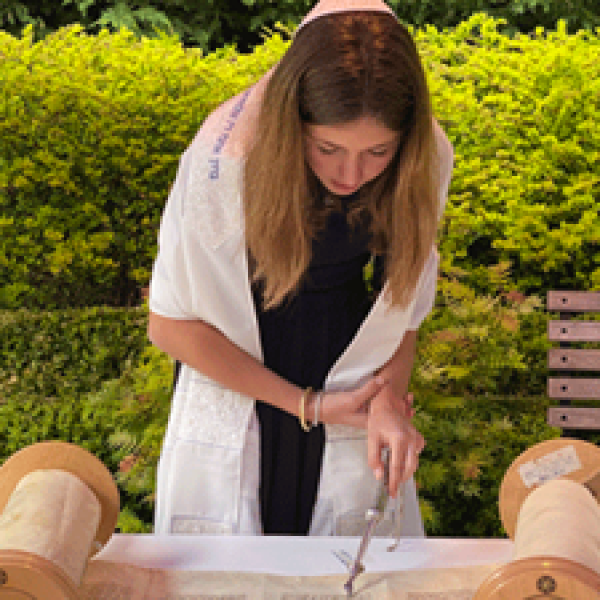
"Our daughter, Sadie Howard, celebrated her bat mitzvah on May 2, 2020, in the midst of the coronavirus pandemic and Washington State’s "Stay Home" orders.
Knowing that we would not be able to share the day with our close friends and family at our synagogue, Herzl Ner-Tamid, we had to find a solution that was meaningful for us and celebrated our daughter's accomplishment.
We borrowed a Torah from HNT, Sadie's tutor, who helped lead the service, surrounded by our immediate family in her grandparents' backyard and our Zoom community all over the US. It was a special day, and we felt so much pride for our daughter, who led the service, read from the Torah, and chanted her Haftorah with so much grace, poise, and confidence, while she beautifully tied her d'var to current events.
Her day ended with a virtual DJ dance party for her friends in our decorated garage."
- Mimi and Billy Howard
Molly Azose
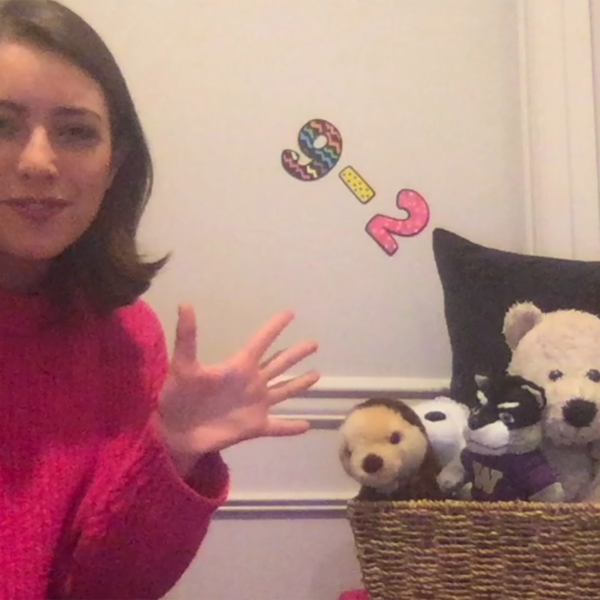
"After saying goodbye to my students that Wednesday [March 18], I heard the news that school was closed effective immediately. As a first-grade teacher and a first-year teacher, I couldn't comprehend what that meant. Over the next few days, we were told we needed to provide resources for our students online. I had to learn how to adapt to curriculum changes and new technology, and boy, was there a learning curve! I went from being an interactive teacher to being an online educator. I had to rethink everything I knew about teaching. How would I make my lessons personalized and engaging? How could I bring my students into the conversation when they were going to watch me through a screen? That's when our first-grade team decided to start making educational videos. Through this medium, I am able to show my authenticity and excitement. I am still learning, but through this process, I am exploring my online creativity and figuring out how to inspire my students and bring them smiles."
- Molly Azose
Mikayla Geisner
"As a student, this worldwide pandemic has largely affected my academic life. However, more importantly, it has impacted my family life. Having my testing delayed and grades for the second semester of my junior year no longer having weight has shaken up my life, but nothing has shaken it more than the implications of all of this on my family. Because of this virus, I have missed some crucial life events such as my cousin's Bat Mitzvah and my grandmother's 80th birthday trip. While these things matter to me, I am also well aware of the fact that all of these are minor impacts and that the gravity of this situation is far worse for many families who are losing loved ones or living in constant fear because they experience immunosuppression. I pray daily for these people’s health and well-being in times of a crisis like this.
Some Mitzvahs that I have seen throughout this time are people giving their money and time to the groups that need it the most, such as the homeless population of Seattle, domestic violence victims, and the elderly who cannot leave their homes. I am currently attempting to raise money for the homeless in Seattle who have no access to their shelters, basic amenities, and healthcare during this time."
- Mikayla Geisner
Abby Carolyn Levine
"Throughout my Jewish education, the teaching that has always stuck with me most is gemilut chasadim, acts of love and kindness. During this difficult time, I have noticed that these moments of selfless love have only become more poignant. An example I have witnessed in my own life was by my grandma and grandfather. My grandparents own a glue company. When they noticed the severe shortage of hand sanitizer in their community, they decided to start producing hand sanitizer in their factories and donating it to local hospitals and nursing homes. While I try to navigate my own anxiety and unhappiness during this difficult time, it is by noticing the gemilut chasadim all around me that I am able to remain optimistic."
- Abby Carolyn Levine
Emma Lynne Poll
"I have started working out every day and am becoming a more active person due to this quarantine. I am staying connected to family and friends via FaceTime. We FaceTime my noni every night and my bubby! People are staying inside to help stop the progression of this virus, which shows the amazing community we have here in Seattle. So far, I have been able to stay home and avoid social gatherings because I understand the severity of this issue and believe it is more important than my current social life.
However, this virus is very frustrating for a student. I am a senior in high school and have many concerns. Will I be able to walk at graduation? Will I be able to go to prom? Grad parties? Senior activities? All the things I have been looking forward to may be gone. From this experience, I have learned that life can change in an instant, and to be prepared and not selfish in these times of need."
- Emma Lynne Poll
Asher Lev Porad
"My everyday life has changed a good amount because of this virus. My exercise and after-school routine, which is normally going to the bouldering gym with some friends, is now biking and watching TV. School is now at home, so for most weekdays I just sit at my desk for 7 hours a day.
I've been staying in touch with my friends mostly through text and other social media. Social distancing was really hard at first because I missed my friends and doing the activities I like to do, but I'm a week or two in now, and I'm starting to get a little used to it, and I've been in a better mood the past few days.
From this experience, I've learned that everyone has to do their part, because if not, everyone social distances, then the virus continues to spread and hurt people, even if it doesn't affect you that much."
- Asher Lev Porad