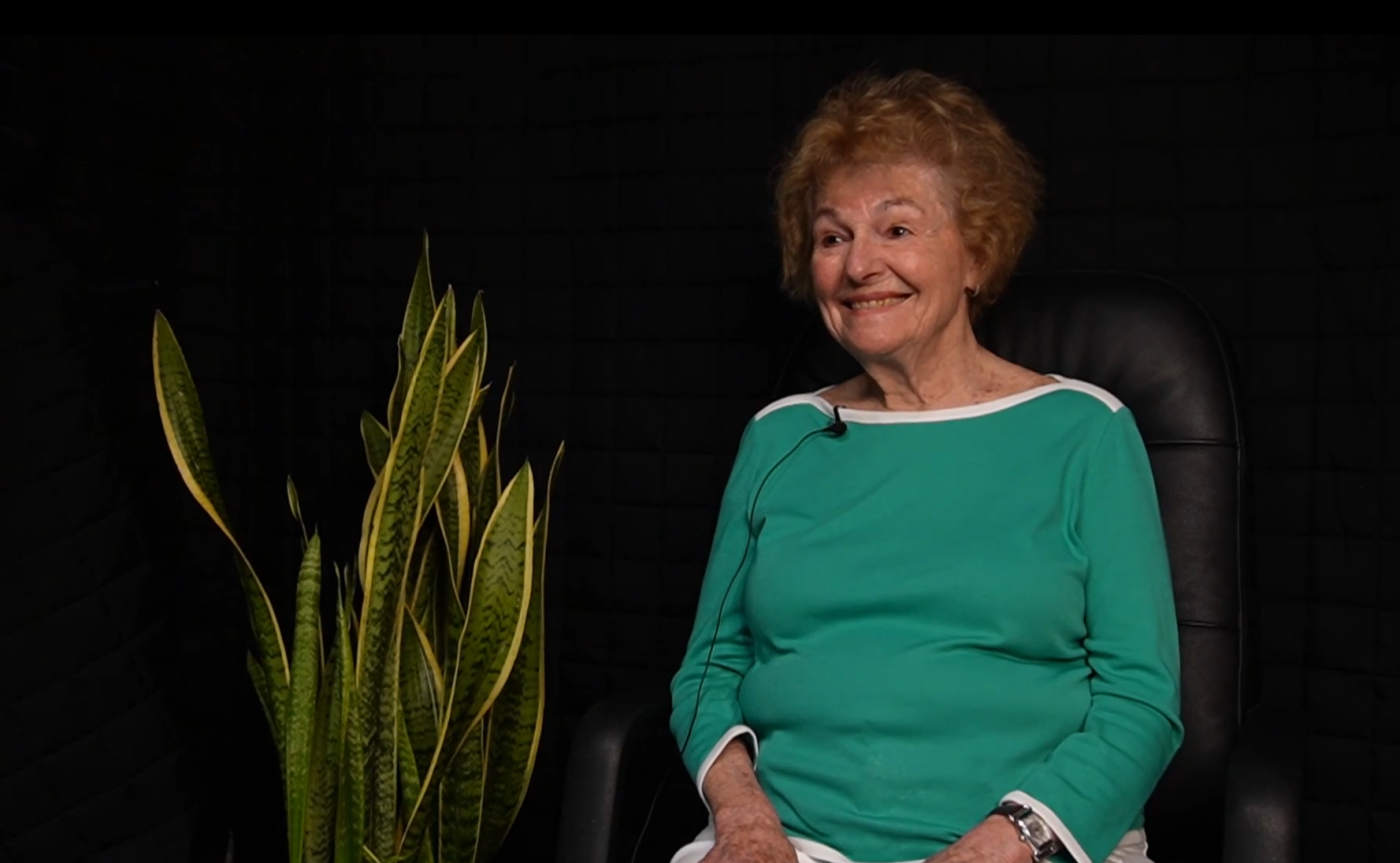
Frankie Loeb shares her family history rooted in European origins and her upbringing in Seattle, including her involvement in her Jewish community and leadership roles. She reflects on her cultural traditions, her experiences moving due to her husband's military service, and the importance of maintaining her heritage. She emphasizes the value of community leadership and personal family joys, especially with her grandchildren and great-grandchildren.
Chapters
00:00:00
WSJHS Staff
[Staff setting up microphone]
00:00:01
Jeff Schwager
So if we could just start, if you could just tell me your name. And I'll say that we're going to be using this oral history on the Washington State Jewish Historical Society's website. And you are..?
00:00:15
Frankie Loeb
Francine Loeb, otherwise known as Frankie.
00:00:19
Jeff Schwager
Okay. And we'll be calling you Frankie, today, if that's okay?
00:00:24
Jeff Schwager
Good. Um, well, if you could start just by telling me how you and your family ended up in the Seattle area?
00:00:32
Frankie Loeb
My grandparents were here. My mother was born in Tacoma, and my father was born in Seattle. Both of their parents were born in Europe.
00:00:43
Jeff Schwager
Where in Europe were they from?
00:00:47
Jeff Schwager
[shrugs] Don't know. Wow.
00:00:48
Frankie Loeb
Well, if I thought about it, maybe, someplace in Russia or something.
00:00:54
Frankie Loeb
Steve? [speaks to son, Steve Loeb, off camera]
00:00:58
Steve Loeb
Your family is from Belarus.
00:01:01
Steve Loeb
And his mom's family? Most of it. Your mother's, uh, father was from a small town in the Czech Republic. And your mother's mother was from Lithuania.
00:01:18
Jeff Schwager
That is the story of our people. They come from all over.
00:01:21
Steve Loeb
All in the Pale of Settlement.
00:01:23
Jeff Schwager
Yes, indeed. Um. So you were born in Tacoma?
00:01:31
Jeff Schwager
You were born in Seattle?
00:01:32
Frankie Loeb
My mother was born in Tacoma. And my, my grandparents, her parents, lived in Tacoma. And my mother was raised in Tacoma. My dad was raised in Seattle.
00:01:44
Jeff Schwager
Uh huh. And, um, where in Seattlw, uh, did you grow up? What part of town?
00:01:55
Frankie Loeb
My grandparents, uh, the Seattle ones lived in Madrona. My father went to Madrona School, which at that time went through the eighth grade, and then went to Garfield High School. And I also went to Garfield High School, but I went to Stevens Grade School and Meany Junior High.
00:02:14
Jeff Schwager
Uh huh. And did you have siblings?
00:02:16
Frankie Loeb
Yes. Sister and a brother.
00:02:19
Jeff Schwager
And, um, are they still living?
00:02:22
Frankie Loeb
Yes. My sister lives in San Francisco. She's four years younger and my brother lives in Las Vegas. And he's ten years younger than me.
00:02:32
Jeff Schwager
Uh huh. Okay. Um, so you've you've lived your whole life in Seattle?
00:02:41
Frankie Loeb
Well, except that when I got married, I moved away.
00:02:46
Jeff Schwager
Oh. Where did you live then?
00:02:47
Frankie Loeb
Well, my husband was in the service and we lived in Harlingen, Texas. In fact, Steve was born in Harlingen, Texas. My husband was in the Air Force as a pilot.
00:03:00
Jeff Schwager
Wow. My father was also in the Air Force. Probably around the same time, he was in Alaska, but not a pilot.
00:03:10
Frankie Loeb
Oh. Well, my husband's the pilot type. He leads. He could have been a navigator. He had his choice, but there was no choice. That's his style.
00:03:23
Jeff Schwager
Was he in during the Korean War or after the war?
00:03:27
Frankie Loeb
Um, sort of. Right between or right after? I'm not sure about the the years, but, Steve, do you?
00:03:36
Steve Loeb
He graduates college, right as the conflict is completing because he graduates in '54.
00:03:48
Steve Loeb
Right, right. My father-in-law is '53. So, he just missed it.
00:03:55
Jeff Schwager
Tell me about the Jewish community when you were growing up, was was it a strong community? Were you heavily involved in it?
00:04:07
Frankie Loeb
Well, I've always been involved in the Jewish community. And I went to Temple De Hirsch Sunday School, and joined, got married there, and continue to belong.
00:04:30
Jeff Schwager
Tell me about your work with the Federation. When did you become involved with the Federation?
00:04:39
Frankie Loeb
I can't really remember, but I've always been involved in the Jewish community. That's where I've done my volunteer work and started in the women's division of the Federation that I know. And then, um, ended up being the president, the chairman, and all of the various duties that, you know, carried out in the Federation.
00:05:09
Jeff Schwager
And how did you choose the Federation as the sort of home for your work in the Jewish community?
00:05:17
Frankie Loeb
Because it serves the whole community, I guess.
00:05:21
Jeff Schwager
Can you tell me about some of the things you you did in the Federation?
00:05:26
Frankie Loeb
Well, actually, I started in the Council of Jewish Women, come to think of it. And, in the Council of Jewish Women, we did reading tutoring, and then one of the, I can't remember the name of it right now, non-Jewish organizations liked that so much that they became involved in arithmetic tutoring. And, um, so that's where I started. And the Council of Jewish Women at that time was a very active women's Jewish organization. And so I sort of followed what they did.
00:06:09
Jeff Schwager
And when was that? Do you know the years at all, or when you might have started, or the decade?
00:06:15
Frankie Loeb
Well, Steve, when were you born?
00:06:24
Steve Loeb
Because you also had the Temple Religion School Committee that you got involved with.
00:06:32
Frankie Loeb
I went to Temple. As I recall, Temple became large because they had a religion school and they didn't charge for people to send their kids to-I mean, in the old days-so, I mean, my grandparents were not Reform Jews. They were Orthodox, but not observant.
00:07:07
Frankie Loeb
Yeah [Laughs]. I don't think they even, they didn't eat treyf. I don't even think they kept kosher in that they mixed their meat and milk. So I think, if I recall. So they were, you know, middle of the road. And they were all European born, the grandparents, they were not born in the United States. My mother was born in Tacoma, and my father was born in Seattle.
00:07:38
Jeff Schwager
Did you know your grandparents?
00:07:44
Jeff Schwager
And were those important relationships with you?
00:07:46
Frankie Loeb
Definitely, and we spent holidays. Now, my mother's parents lived in Tacoma, so a lot of times we met them on Sundays at Rosie's Chicken Dinner or Restaurant, whatever it was called, because it was halfway between Seattle and Tacoma. And then, of course, the Shulman grandparents lived in Madrona. And so we did a lot of things with them and went to the many holidays there when we didn't drive to Tacoma.
00:08:22
Jeff Schwager
And did they speak Yiddish?
00:08:23
Frankie Loeb
Oh, yes. They all spoke Yiddish.
00:08:32
Frankie Loeb
My parents, I think, spoke enough Yiddish because their parents on both sides spoke Yiddish, but they also spoke English. And the grandparents spoke English because they had to.
00:08:46
Steve Loeb
I have an interesting story for you that she's not remembering.
00:08:50
Steve Loeb
Her grandparents were the generation of "you're American, you speak English."
00:08:56
Steve Loeb
They spoke Yiddish when they didn't want their kids to understand what they were saying.
00:08:59
Frankie Loeb
[laughing] Right. That's true.
00:09:00
Steve Loeb
My wife's Italian grandparents did the same thing. But one of her uncles, Sam Schulman, learned Yiddish because his wife, your Aunt Pearl, her father was an Orthodox rabbi in Portland and had eight kids, so he learned to speak Yiddish. It's relevant because when we brought people that mom helped with from the Soviet Union, from Belarus. In '89, a cousin arrives, and we bring out her dad's first cousin in '91, along with a bunch of other family members. My Uncle Sam became, they spoke Russian and Yiddish.
00:09:41
Steve Loeb
So we don't speak Russian. So Uncle Sam could speak with them in Yiddish. And through her dad and her.
00:09:51
Steve Loeb
We got them resettled here.
00:09:52
Jeff Schwager
And he was the translator. That's great. Yeah. My mother spoke Yiddish, and her grandmother only spoke Yiddish. So similar situation. I wanted to ask you about the Leadership Institute with the Federation, and just ask you to begin with, what inspired you to make this incredibly generous donation that you made to the Leadership Institute?
00:10:22
Frankie Loeb
Well, I was very active in the Federation and started in the women's division because we had a women's division, and then I chaired the women's division. And then I think I was the first chairman of the campaign, the overall campaign, not the women's division, you know. So, and then that became the overall, and eventually the women's division was absorbed into the regular campaign, but I sort of got that started.
00:10:58
Jeff Schwager
Yeah. And why leadership in particular? Why has that appealed to you as a focus of your philanthropy?
00:11:08
Frankie Loeb
Well, I think I always was appointed a leader in school. I skipped a grade. Which I was smart, obviously, I wish I was as smart now [Laughs].
00:11:24
Jeff Schwager
Don't we all wish we were.
00:11:28
Frankie Loeb
[Laughs] Somewhere along the line, it got a little bit lost. But anyway. So, um, I skipped a grade. And my birthday's in September, so I was the youngest before I skipped a grade in my-And then when I skipped a grade, I was really the youngest. But I always managed. And I did, like, I had a really good friend that lived on our block. I was raised in Capitol Hill, and, um, she was, because I skipped, she was a year older than me, and my mother had a car, so she was able to drive my mother's car because we were a two-car family. So we had our freedom a little earlier than some. But as I say, we were in the same grade, but she was a year older, so she got her driver's license in May, and I didn't get mine until a year later in September. So I was lucky I had a driver. We had a little freedom because of that. Steve, you're looking.. [Cut off].
00:12:46
Steve Loeb
Community strength, and community infrastructure has always been a thing for mom. The strength of the overall community.
00:12:56
Steve Loeb
And as we, I was working with Federation, we felt that one of the ways to build the community is to build the human capital of the community.
00:13:06
Steve Loeb
This is an investment in the human capital for the growth and leadership of the community.
00:13:12
Jeff Schwager
Mhm, absolutely. Um, and so you have created a lifetime, a lifetime achievement award for creative leadership, for courageous leadership. Um, I'm curious, uh, who are some of the courageous leaders you've known in your life who've meant a lot to you in your development?
00:13:35
Frankie Loeb
Well, um, I always looked up to Sam Stroum. He did a lot for the Jewish community, and he was a good leader. And Becky Benaroya, I looked up to her, I still do. And, Bernice Rind, we were good friends, and she was, uh, she and her husband, Marty Rind were Jewish community leaders and did a good job. And they were, you know, people that were a little bit older than me so I looked up to them and hoped that I followed in their footsteps.
00:14:19
Jeff Schwager
Mhm, Yes, well those were all wonderful people in the community. I got to interview Becky once, and that was a real treat. In your experience, what are the most important characteristics that make someone an effective leader?
00:14:42
Frankie Loeb
Well, they have to start by having-showing a good example. And, um. And being able to recognize the leadership qualities in other people and encourage them.
00:15:06
Jeff Schwager
Yes. Those are great characteristics, uh, that we should all strive to have.
00:15:15
Frankie Loeb
I'm glad I remembered them [Laughs].
00:15:19
Jeff Schwager
And it seems like in the modern world, I'm not sure that those characteristics are as valued as we would like.
00:15:25
Frankie Loeb
Oh, well, starting with Mr. T.
00:15:30
Frankie Loeb
Um, if he's a good example, we're on the wrong path. My opinion [Laughs].
00:15:36
Jeff Schwager
Yes. I think that is a widely shared opinion among people I know. Um, one of your great accomplishments in the community, and Steve was just talking, uh, about that, was your work with the refugees from the Soviet Union. And I guess that started with your own family?
00:15:58
Frankie Loeb
And, and I, I think that I took a trip to the Soviet Union with the Federation Director, maybe Michael Novick or whoever was before Michael Novick.
00:16:12
Steve Loeb
Murray. Murray Shiff. Or Mel Libman,
00:16:15
Frankie Loeb
No, neither of them. Maybe it was Michael. I just can't quite remember but we did go to the Soviet Union and met with people that were coming over or looking to come over, which was certainly very eye-opening.
00:16:37
Jeff Schwager
Yeah. Tell me about that. What was eye opening about it?
00:16:40
Frankie Loeb
Well, people didn't run to Europe in those days. I mean, nowadays, I think people are more-that travel to get to Europe. But I think that was, in those days, unusual. And I remember that Michael Novick got all excited about being over where his family had come from, because that was a different experience. That was a newer experience. Then he got involved in one of the national organizations. I'm trying to think of.
00:17:21
Steve Loeb
Well, he went to work for the Joint, the American Jewish Joint Distribution.
00:17:24
Frankie Loeb
Yes, JDC. And that was because we'd been on this trip, and he realized that some of his relatives had come from these areas and everything. Yes. And he did get involved with them.
00:17:40
Jeff Schwager
And when you were in the Soviet Union, were the conditions that people were living in shocking or not?
00:17:50
Frankie Loeb
Not really, but I don't remember that much. I remember being in a synagogue and speaking with people, but I don't think we went into where they lived.
00:18:05
Frankie Loeb
I'm sure we didn't, but I can't remember the details, I admit.
00:18:10
Jeff Schwager
So were the people that you were bringing over, were they like the Refuseniks that we heard about, or don't remember?
00:18:24
Frankie Loeb
Well, I don't really know. I remember the term Refuseniks and Steve you're looking like...
00:18:31
Steve Loeb
Her activity in that time, those are definitely Refuseniks. Because her activity is particularly in the early '80s.
00:18:40
Steve Loeb
And that's the sort of the Perestroika Era. Later the group that our cousins came from, they were more economic refugees. They come in '89 and '91. Actually, that's the Perestroika group.
00:19:00
Steve Loeb
So our cousin that came in '89 was the last of the group that went out by train to Vienna, then to Rome, and came here. By the time two years later, when we brought them, his dad and siblings, they literally got on a plane in Minsk, they flew to Moscow, to New York, to Seattle in 36 hours.
00:19:22
Frankie Loeb
That's right. They came from Minsk. All the Shulmans came from Minsk. My grandparents came from Minsk.
00:19:32
Steve Loeb
I was board chair at Jewish Family Service around that time [Laughs]. So we were doing the resettlement.
00:19:37
Jeff Schwager
Yes, so in '89, things opened up a lot.
00:19:41
Steve Loeb
And it was a different group, but her group, that was the Refuseniks.
00:19:46
Jeff Schwager
Yes. It was really a wonderful thing to get those people out of Russia when it was still the Soviet Union, and there was a lot more discrimination at that time. Tell me about, some of your other sort of achievements in life and things that you're proud of, that you accomplished either with the Federation or elsewhere.
00:20:18
Frankie Loeb
Help me, Steve. [Laughing]
00:20:23
Jeff Schwager
Well, tell me about raising your family. How many kids do you have?
00:20:28
Jeff Schwager
Two sons. We've got Steve here, and also...
00:20:34
Frankie Loeb
...younger brother, Don, uh-huh. And they have lovely children. So we have lovely grandchildren. And we even have a great grandchild. Steve is a grandpa.
00:20:49
Steve Loeb
Turns three on Wednesday.
00:20:51
Frankie Loeb
Yes. Got her present. Looking forward to her party. And she's a little pistol [Laughs]. I get a kick out of my granddaughter, sends little things on the computer or on my phone, and she's got a little mouth on her. It's really very cute.
00:21:16
Frankie Loeb
Yes, well, she's three or going to be three this week.
00:21:22
Jeff Schwager
What did you, um, tell your children about the Jewish community and the Jewish religion as they were growing up? What sort of lessons did you want them to know and not forget?
00:21:37
Frankie Loeb
Well, I sent them to Sunday school, and wanted them to pay attention and learn from that. And I think we lit the candles on Friday night. Did we Steve?
00:21:51
Frankie Loeb
I thought we did. We weren't real observant and didn't keep kosher, but, we even had a little bacon. And then Don went to camp in the east. Don being Steve's brother. And there was an Orthodox rabbi that had an older congregation, and he liked going to this camp in the summer to be with younger people because his congregants were older. And so he got him into, you know, not eating bacon and things like that. And I remember when Don came back, at first he tried to be observant and he, you know, he was, but I'm sure over the years he switched back and does like the rest of us.
00:22:51
Jeff Schwager
So in your experience, it's more the cultural aspect of Judaism that has been important rather than the religious aspect?
00:22:58
Frankie Loeb
Yes. Of course. Definitely.
00:23:01
Jeff Schwager
Yeah. Um, yeah. Same thing with my family.
00:23:06
Frankie Loeb
Well, you know, the temple got big because they had a Sunday school, and I don't think in the old, old days that they charged for Sunday school. So a lot of people that tended to be orthodox, but they wanted their kids to have some Jewish background, would send them. And I think if I recall that, um, at some time, my father started dating girls that weren't Jewish, and I think my grandparents joined a temple or something because they wanted to set a good example, you know.
00:23:47
Steve Loeb
And your grandparents, those grandparents were Workmen's Circle. So.
00:23:53
Steve Loeb
Being raised observantly. That was not an observant life.
00:23:57
Frankie Loeb
Yeah. The workmen's Circle my grandfather was very active in. And I'm not sure that's a Socialist organization, I believe. Right?
00:24:07
Steve Loeb
Yes. In pictures, they went to some of the national conventions.
00:24:11
Frankie Loeb
Yes. There were pictures of my grandfather was active in that. My father's father.
00:24:18
Frankie Loeb
Yeah. My mother's parents lived in Tacoma, and they had their friends. They had a lot of Jewish friends. And in fact, the Shulman grandparents all called their friends by Mr. and Mrs. But the Tacoma grandparents, a couple of their friends, they called them by their first names. But you know coming from the old country, that was their way with the Mr. and Mrs., with their you know, they were young people, and I don't...
00:24:52
Frankie Loeb
Yes, more formal. I don't really know. I know the Shulmans that's my father's family. My grandfather got here because he had a landsman that was here because they all came to New York. And I don't know how the Willner's, how they happened to get. I mean, Uncle Morris was active and he had a store and things, and he probably was the more, well-heeled of the Willners, and probably encouraged or brought them out. There used to be on, um, I think it was on Cherry Street, Willner's Bargain Store. That was Uncle Morris's store.
00:25:41
Frankie Loeb
That was in the old-you know, when I was a kid. And like, there were a couple, uh, Aunt Helen and Aunt Julia. Aunt Julia was married to Uncle Morris and Aunt Helen was married to Uncle Izzy. And they worked in that Willner's Bargain Store, and I think it was on Cherry Street, but, you know, around 23rd, but not 23rd and Cherry, but someplace on Cherry there. Well, that was sort of the Jewish neighborhood. Brenner's was there. Brenner's Brothers was on Cherry Street. And, you know, my dad went to Garfield High School. His parents lived in Madrona, which was pretty upscale in those days.
00:26:28
Frankie Loeb
And, um, and, and but that was sort of the Cherry Street was the Jewish neighborhood. When-even when I was in at Garfield High School, I think. But that's that was there was a delicatessen there. I can't remember I can't remember the name now.
00:26:51
Frankie Loeb
Was that Bluma's [Mannhalt] on Cherry Street? Okay. Because [And her brother] Oh, okay. Because Del's delicatessen was on 15th in Capitol Hill. That was already a little more upscale because we lived on 20th, and we used to every Friday, I think we'd stop. My mother and I had an appointment downtown at Frederick's to have our nails done or something, and we would stop on 15th at Dell's Delicatessen. Her name was Della Gottstein. And Dell's was the delicatessen. And we'd pick up dinner that we always had Friday night, which was Jewish Delicatessen. That was our Shabbat dinner. We didn't call it Shabbat either, but that was our Friday night dinner when I was growing up.
00:27:46
Frankie Loeb
Yes, yes, we lost that tradition along the way.
00:27:51
Jeff Schwager
We seem to have lost most of the delicatessens in Seattle, too.
00:27:59
Jeff Schwager
I wanted to ask you about being the first woman, board chair at the at the Federation in Seattle. That must have been quite an honor for you.
00:28:11
Frankie Loeb
Um, when I was asked to do that, obviously, they couldn't find a man to do it. That's no question about that. But Marty Rind had a group of men that he called a meeting and had me at the meeting and got a commitment from those men that just because I was a woman, you know, I wasn't, we still had a women's division, but they couldn't get a man to be the president, and they asked me to do it. But he got a commitment from the men that they would work the campaign, for instance, because it wasn't a woman's campaign, it was the general campaign. And so I remember him, he was a terrific person, Marty Rind, I don't know if you ever knew him or anything, but he was outstanding. Bernice was his wife as well. But he set, a very good example, let's put it that way. And I always admired him.
00:29:21
Jeff Schwager
Was there sexism did you feel as the first woman chair? Is that something you had to deal with?
00:29:28
Frankie Loeb
I don't think so. Although. Well, I remember that once I called Joe Diamond on a [Microphone rustling]
00:29:42
Frankie Loeb
I call, I called Joe Diamond. He was, um, first of all, a next-door-neighbor of my parents. And he and my father, I believe, grew up together. And, he was an attorney. And I called him on a Monday morning about something with the Federation. And he gave me very good advice that you don't call a businessperson on Monday morning to ask him for something for philanthropy. I'll never forget that, because I just had, you know, my day started Monday morning, and I hadn't thought about that, the timing was important as to when you approached people, especially to ask them for money. Or to ask them to work to ask for money, you know, because that that was more what I had to do when I chaired it.
00:30:46
Jeff Schwager
Was that, um, a difficult thing for you to ask people for money and to do the fundraising?
00:30:54
Frankie Loeb
I'd rather ask people to ask people.
00:30:58
Jeff Schwager
Yes. I've always found that incredibly challenging myself.
00:31:05
Steve Loeb
You had a statement earlier that about sexism that, um, you may want to say again that the men always came first.
00:31:16
Frankie Loeb
The men always came first?
00:31:18
Steve Loeb
The interests of the men came before you. And that's actually sexism.
00:31:30
Frankie Loeb
I don't know that. Is it still that way, Steve? I think that.
00:31:40
Steve Loeb
Depends what people wish to see. Uh, it's...I don't think there's as much sexism, but it's easy to call something sexism when you don't get your way. So, sometimes it is.
00:31:53
Frankie Loeb
And sometimes it isn't. It depends on who's whose axe is being ground or whatever that expression is.
00:32:04
Jeff Schwager
I think it's less overt now. Uh, it's probably a little more subtle. Whatever sexism there is. Um, but it certainly depends who, uh, who's in charge.
00:32:19
Jeff Schwager
Um, the last couple of years have been incredibly difficult for Jews. Uh, in Seattle, across the country and across the world. I wonder what message you would, uh, send to the Jewish people at this time. Just as as a leader of the community and as someone people look up to. What do you say to people who are worried about the future of the Jews.
00:32:45
Frankie Loeb
To hang in there and do the best you can, and don't give up and don't fold up.
00:32:56
Jeff Schwager
Good advice. And what about Israel? How are you feeling about Israel now? And what do you tell people about the situation in Israel?
00:33:04
Frankie Loeb
We don't discuss it. Plain and simple. I mean, I read everything, and I certainly am on Israel's side and everything that I've read, but I don't know. We just don't discuss it. Do you discuss it? [Addresses Steve]
00:33:28
Steve Loeb
I discuss it with the people that I know are more closer to my viewpoints, and I'll discuss it frequently in my other volunteer work with those who don't. But we'll have to. I don't go looking for the challenge, but we must stand up for ourselves.
00:33:49
Steve Loeb
And so I get involved in discussions. I won't just go ask "Hey, how do you feel about Israel?" But if someone says something that I don't agree with, I will go wade right on in.
00:34:02
Frankie Loeb
Well, and nowadays, generally, the people that I see are mostly Jewish people. Many live in our building. We live in a building downtown and, um, it's very nice. We live in Arizona in the winter and, um, don't have as many Jewish friends down there and don't live in a building. We live, you know, we belong to a golf club and things like that. But, so we have friends. But, um, the weather's a little nicer in Arizona in the winter, I have to tell you [Laughs]. But it's much nicer here in-and of course, our families here, so.
00:34:50
Jeff Schwager
Yeah, you wouldn't want to be in Arizona in the summer?
00:34:54
Jeff Schwager
Yeah. I used to go every year for spring training to see the Mariners.
00:34:58
Jeff Schwager
I spent a lot of time in Arizona. Yes. Well, is there anything else you'd like to share or tell me about your life? That that, uh, is something-any lessons you've learned? Any lessons that's important that I've-I haven't covered?
00:35:22
Frankie Loeb
Not really. You know, anything that's Jewish I'm interested in. There's just-I don't know why, but that's the way I've always been. So I've always, you know, if I'm going to be on a committee, I'd rather be on a Jewish committee. And, um, I remember Junior League used to have reading tutors and or maybe they had arithmetic tutors. And so I got the Council of Jewish Women. I was active in that organization, which I don't think is an organization anymore. But, um, if if the Junior League was doing arithmetic, than the Council of Jewish Women was doing reading tutoring in the Seattle Public schools. So we sort of and there were we had a nice relationship between the the two groups.
00:36:23
Steve Loeb
You also served on the board of United Way of King County.
00:36:26
Frankie Loeb
Okay. So it wasn't just just Jewish things. Yeah, I forgot about that, but I was busy.
00:36:38
Jeff Schwager
Yes. [Laughs]. Sounds like you did a lot. It sounds like you have a lot to to be proud of and look back on.
00:36:46
Frankie Loeb
Now I'm busy playing bridge or mahjong.
00:36:52
Frankie Loeb
And, and I do that-well, I do it online. But I also do like Thursday is mahjong day. I do enjoy it. My granddaughter, Steve's daughter, plays with us and it's very nice.
00:37:11
Frankie Loeb
Yes, yes, all those things are nice. And it's nice to be here because the family's here. In the winter, we're down in Arizona. The weather's better, but it's nicer up here with the family. I think we probably spend a little-we may have been 50:50, but I think we're tending to be a little longer here because of family.
00:37:36
Jeff Schwager
Well, that's the most important thing.
00:37:40
Jeff Schwager
Yes. Well, thank you so much for doing this. It's really a pleasure to talk to you.
Related Tags
Tacoma
Seattle
Lithuania
Czech Republic
Garfield High School
Jewish Federation's Women's Division
Jewish Federation Council of Jewish Women
Yiddish
Leadership